Night of Knives
By Ian C. Esslemont
(Bantam Books, mass-market paperback 2008)
With the success of Steven Erikson's Malazan Book of the Fallen novels, and the plaudits his writing has earned, it's easy to forgot that the Malazan world was co-created by Ian C. Esslemont, who was Erikson's gaming and screenwriting partner for many years.
It's therefore fitting that Esslemont's first foray into the world he co-created has finally received a mass-market release, after originally being published in hardback by PS Publishing, a small UK press.
Esslemont however was faced with a problem that 99% of first-time writers don't have: a large, hungry readership with high expectations. This put him at a disadvantage right from the start, and the unavoidable comparisons with Erikson's own novels meant that Esslemont's debut offering was sadly never really going to be assessed on its own terms.
Comparing Night of Knives to Erikson's established novels, is in my opinion, both subjective and unfair. Yet at the same time, given that Esslemont is writing about places and characters that have appeared in Erikson's own works, it is to some extent unavoidable. In this review therefore, I shall endeavour to be as objective as I can but there will be times when comparisons are made.
Night of Knives focuses on an event that has previously only been hinted at by Erikson - the assassination of the Emperor Kellanved and his companion Dancer, by the would-be Empress Surly. Set over the space of a single night, the action takes place on the backwater Isle of Malaz, during a once-in-a-generation event: the Shadow Moon. As dark beings stalk the streets and the barrier between worlds is blurred, a brutal conflict breaks out between a number of factions...and the events that unfold will change the world. Into this maelstrom of treachery and deceit come Temper, a war-weary veteran, and Kiska, a young thief and would-be Imperial spy.
Straight away you can see that Esslemont's writing is very different from Erikson's. Esslemont writes with a real sense of urgency, and his style is more accessible and less dense. It's also, if I'm honest, not as good as Erikson's. Esslemont is by no means a bad writer; his action scenes pack a punch and he can conjure up some nice atmosphere with his descriptive prose. However there's just not as much going on beneath the surface as there is with Erikson. Esslemont doesn't manage to convey the sense of history of the world or the importance of the unfolding events as well as Erikson does in his own work. In addition, some of the dialogue is a little stilted at times and some of the language is repetitive. To some extent I think Esslemont was held back by the plot, which doesn't really allow for much variation in the locale. It's no coincidence, to my mind, that the best writing in the book is in a flashback chapter, detailing a well-known siege and the events the occurred there. When given the chance to do something more epic in this chapter, Esslemont manages to deliver much more convincingly. This definitely bodes well for his next book, The Return of the Crimson Guard, which should give him plenty more scope.
Esslemont's characterisation in Night of Knives is hit and miss. Temper, the weary veteran, is a well-rounded character who is easy to sympathise with and whose background is sufficiently explored. Kiska, on the other hand, is a rather shallow character whose sole purpose in the book seems limited to constantly getting captured by the various factions, and then expressing her irritation at her own limitations. While Temper has a reason to get involved in the night's proceedings (old scores to settle), Kiska is a bit of a spare part with no real point as to her involvement, other than to explain her background a bit, as I understand she appears in Erikson's later novels. Her character is at times unconvincing. For example, there's one scene where she "forces down some bile" as she witnesses a soldier get torn up by a shadow hound, before the beast then chows down on him. That just isn't realistic at all. She's a teenage girl with no real survival or combat experience, for goodness sake. Yet she handles the situation like a seen-it-all veteran. Unconvincing to say the least. The two protagonists aside, we do get to see some other familiar characters from Erikson's books (I had a bit of a 'geek' moment when Hairlock made an appearance). Generally however Esslemont's characters are just not as appealing as Erikson's; they aren't as world-weary, or as cynical, or as wryly amusing.
There's no doubt that Esslemont tells his story well enough, and the plot does allow for one or two twists and surprises. There are certainly a number of important events, and some very cool aspects (I loved the Riders, for example, and am looking forward to reading more about them in Erikson's The Bonehunters). The pacing of the novel is probably its strongest part. It is disappointing however that the two most important confrontations of the novel both occur 'off screen' and so subsequently we don't get to witness them. It doesn't defeat the point of the novel, but it certainly lessens the intensity of the story's impact on the reader. One or two of the plot's more minor events do come across as a little contrived. For example, when a brash young soldier threatens Temper and his companions, it seems the only point of the soldier's actions is to give Temper a route out of the situation he finds himself in.
Given Esslemont's more accessible writing style, I thought that perhaps Night of Knives would be a better starting point for newcomers to the Malazan world, rather than Gardens of the Moon. Having read both books, I firmly believe Malazan virgins should start with Gardens. It is likely that if you read Night of Knives first, much of the importance of the events will be lost on you. Plus you probably wouldn't have a clue what was going on. In any case, Gardens is a superior novel in every respect.
Overall, Night of Knives is a decent novel with good pacing and one or two solid characters. There's plenty here for Malazan fans to get their teeth into. It's let down though by some weak characterisation and one or two problems with the plot. As harsh as it may sound, you do kind of wish that Erikson had written this book. Erikson makes it clear in his foreword that Esslemont's book isn't fanfic, but at times it does feel a bit like it. Perhaps this is to be expected when an author writes a story in the same world as a more established, popular writer. In any case, Esslemont has shown enough in Night of Knives to convince me that there is more to come from him, and hopefully his next work will be a more convincing example of his ability.
Verdict: ddd
Recommended for fans of: Steven Erikson
Friday, 16 May 2008
Book review: Night of Knives
Thursday, 15 May 2008
On the horizon...recommendation for 2008
The Inferior by Peadar Ó Guilín was actually published in 2007, but there's been a bit of a buzz building up around it recently.
Here's the blurb:
There is but one law: eat or be eaten. Stopmouth and his family know of no other life than the daily battle to survive. To live they must hunt rival species, or negotiate flesh-trade with those who crave meat of the freshest human kind. It is a savage, desperate existence. And for Stopmouth, considered slow-witted hunt-fodder by his tribe, the future looks especially bleak. But then, on the day he is callously betrayed by his brother, a strange and beautiful woman falls from the sky. It is a moment that will change his destiny, and that of all humanity, forever.
Love that first line: "eat or be eaten." That's a brilliant hook. From what I've read, The Inferior takes place in a world far removed from the usual fantasy trappings, where a tribe of humans - living amid the ruins of some long-forgotten city - fight a daily struggle against all manner of nasty critters. There is also a vague sci-fi element as well, with the strange globes that travel in the skies, just to mix things up a little.
Quite a lot has been made of the book's 'young adult' tag, which some reviewers have found surprising given the cannibalistic, survival themes that pervade the story. Still, that's marketing folk for you.
From what I've heard so far, I'm definitely going to be checking out The Inferior as soon as possible. A review will of course be up as and when. In the meantime, feel free to check out some of the reviews already posted throughout the blogosphere by my fellow bloggers:
Review at Realms of Speculative Fiction
Review at The Wertzone
Review at Graeme's Fantasy Book Review
Wednesday, 14 May 2008
Fantasy worlds
I saw a thread on SFFworld about the best and worst fantasy worlds and thought it would be fun to talk a little bit about my personal favourites. In no particular order, my favourite fantasy worlds are:
Tuesday, 13 May 2008
Recommended reading: George R. R. Martin
Monday, 12 May 2008
Top author poll from Westeros
Thanks to Adam from The Wertzone for the heads-up on this one.
A poll was carried out over at Westeros (the George R. R. Martin forum) asking members to vote for their favourite genre authors. The top 10 result was as follows:
1) George RR Martin
2) JRR Tolkien
3) R. Scott Bakker
4) Gene Wolfe
5) Robin Hobb
6) China Mieville
7) Steven Erikson
8) Stephen R. Donaldson
9) Joe Abercrombie
10) Frank Herbert
Admittedly the poll is rather subjective given that it was conducted on a George R. R. Martin forum, but to my mind Martin deserves 1st place. In short, he's the best writer of epic fantasy of all time. Although I do feel Feast was a let-down.
Abercrombie deserves his place in the top 10. He's written one of the most enjoyable fantasy trilogies of recent years, and deserves respect for managing to not just deliver books two and three on schedule, but also for maintaining the high standards he set with The Blade Itself.
Erikson was lower than I thought he would be. Bakker was much, much higher than I expected.
I'm always surprised by the popularity of Robin Hobb's works, especially given the poor reviews her more recent books have garnered from some quarters.
Notable absentees from the top-10 included:
Scott Lynch (11th place): while I thought Lies was a terrific novel, I thought Red Seas was a big disappointment. To my mind, he's not done enough to prove himself worthy of being in the top 10. If his next novel is as good as Lies (or somewhere close) then perhaps 11th place will be more justified.
J. K. Rowling, (no votes at all): I'm not surprised by Rowling's omission. I doubt many of the members on Westeros actually read Harry Potter and even if they did it's unlikely they'd vote for her. Plus, she's hardly endeared herself to serious fantasy fans, has she? First there was the "I don't write fantasy" nonsense that incurred the wrath of Terry Pratchett, among others, then the Hugo snub. On top of that, she's developed an alarming habit of suing the arse off anyone that so much as whispers "Harry Potter." So it's not hard to see why she's been ignored. In addition, she's not much of a writer. Great storyteller, certainly, but not a great writer.
Friday, 9 May 2008
Lazy linkage...
As Friday is lazy can't-be-arsed day, here's some lazy links for you relating to cool/interesting stuff around the genre blogosphere:
Author Adam Roberts has posted a very funny review of The Steel Remains by Richard Morgan over on his BLOG.
Graeme's had a nasty week reading urban fantasy, and has written a rather amusing review of Laurell K. Hamilton's 'Blood Noir' HERE.
Realms of Speculative Fiction have reviewed The Red Wolf Conspiracy by Robert V. S. Redick, and come to much the same conclusion as myself...check out the review HERE.
Jeff over at Fantasy Book News and Reviews has reviewed Bloodheir by Brian Ruckley HERE.
Sara over at Jumpdrives and Cantrips has posted a review of Leviathan Rising by Jonathan Green, a book I'm quite keen on given that I loved Green's Fighting Fantasy work...check out the review HERE.
Thursday, 8 May 2008
3 for 2 book deals will wreck my bank balance...
Went into Waterstones to pick up The Briar King by Greg Keyes, after having heard many good things about that series.
Instead, I came away with three books...none of which were The Briar King. It's these 3 for 2 book offers. I can't help it, I just have to partake.
The books I walked away with were:
Reaper's Gale by Steven Erikson
Children of Hurin by J. R. R. Tolkien
Night of Knives by Ian C. Esslemont
I'm far away from being ready to read Reaper's Gale, but I'll get there eventually. The paperback copy of Children of Hurin is pretty cool and has plenty of excellent illustrations, both colour and pencil. As for Night of Knives, I'm very eager to see Esslemont's foray into the Malazan world. The fact that the novel is set over the course of a single night is also very interesting.
As I had some credit left on my voucher card thingy (kindly given by work colleagues for my birthday a few weeks ago) the whole total that I technically spent only came to around £5. Just as well really, otherwise my wallet would probably have burst into flame.
Wednesday, 7 May 2008
Anomander Rake
I'm aware that this artwork of Anomander Rake from Erikson's Malazan novels has done the rounds before, but who cares. It's damned cool, and deserves to be shown again.
Tuesday, 6 May 2008
Book review: The Black Company
The Black Company
By Glen Cook
(Tor, 1984)
Having read and enjoyed Erikson's Gardens of the Moon, I was curious about Glen Cook's work. I knew that Erikson had admitted the influence of the Black Company novels on his own work, so I was intrigued to check them out for myself. Plus, let's face it, The Black Company just sounds cool. I mean, a novel with that title just can't be rubbish, can it?
The Black Company of the title is an elite group of mercenaries, and the novel follows them as they flee from the troubles of the city of Beryl, only to find themselves dragged into a war between the Lady and the Rebel. As the war reaches its climax, the line between friend and foe becomes increasingly blurred...
It didn't take me long to realise that The Black Company was not at all similar to the other fantasy works of the same time period that I'd read. For example, when it was published in 1984 Terry Brooks was working on his epic Shannara series and Ray Feist had, just two years before, delivered the all-time great fantasy novel Magician. Epic was therefore big business, fantasies with elves and dwarves were all the rage. It was interesting to find out that The Black Company shied away from all this, heading in a very different direction.
For a start, it doesn't make use of the traditional tropes that Brooks and Feist indulged in. There are no elves or dwarves, no dark lords. In fact, Cook focuses intently on the men of the Black Company, exploring their relationships, emotions and beliefs. It's a stripped-down approach that portrays a world where everything is cast in shades of grey and evil is simply a matter of where you stand. In short, it's a more realistic take on things. You could even argue that it's the forerunner of today's 'gritty' fantasy novels (by today's standards it couldn't really be called gritty - no sex, no graphic violence, minor swearing - but by the standards of the 80s it sure as hell could).
The plot, as mentioned, follows the trials and tribulations of the Black Company as they find themselves - somewhat unwillingly - conscripted into a war. The story is seen through the eyes of Croaker, the company's physician and erstwhile historian, and the first-person narrative leaves plenty of room for introspection and exploration of various themes in between the action.
The characterisation is one of the novel's strongest aspects; Cook portrays the men of the Black Company - and their relationships - with commendable realism. Black Company novels are apparently popular among members of the armed forces, and it is easy to see why: Cook's soldiers act like real soldiers. They fight, bitch, argue, laugh and support one another. Their relationships add some real depth and realism to the novel. Lighter moments are also provided by the amusing antics of the wizards Goblin and One-Eye, who constantly strive to out-do each other with their little tricks.
Croaker himself is a likeable narrator, a regular guy who is just trying to do his job. His plain honesty and genuine love for his comrades endears him to the reader, and it's intriguing to see him slowly unravel as the stakes get higher. We see all the action through Croaker's eyes, and subsequently share his thoughts about the nature of evil, the hopelessness of war and the importance of loyalty and honour. It's impossible not to sympathise with the nasty situations he finds himself in, and to desperately hope that he makes it through as the screw tightens.
The human characters are only one side of the coin however. Alongside them, you have the 'Taken' - ten powerful wizards that were enslaved by the Dominator, and now live to serve the Lady. It's these figures that add a more fantastic edge to the proceedings, with their magical abilities and unnerving appearances. For example, Soulcatcher's voice changes from scene to scene, female one minute and then male the next, while Shapeshifter is - you guessed it - able to assume different forms. It's the Taken that to some extent drive the plot along, with their incessant infighting and plotting, despite all being technically on the same side.
The plot itself rattles along at a frenetic pace, giving few clues as to where it's going and managing to spring a few surprises as it reaches its climax. Cook shies away from the heroic quest aspect and instead tells an absorbing story of covert missions, assassination attempts and nefarious backstabbing. While the focus of the novel is relatively narrow, concentrating by and large on the fortunes of the Black Company and Croaker himself, the final battle is surprisingly epic. Cook makes good use of the events to highlight the horror and pointlessness of war, and the helplessness felt by those caught up in it.
There are some aspects I felt could have been handled better. Cook's worldbuilding doesn't match his characterisation and sometimes I felt I didn't have as good a grasp of the world as I could have done with a touch more exposition. Sometimes it feels like the war is being fought over place-names rather than actual cities. In addition, magic is prevalent in the novel but there is no explanation as to how it works, meaning it is hard to appreciate magic use, as you have no real idea how difficult it is for the users to summon the power that they do. Both of these points can largely be forgiven on the basis that this is Cook's first novel.
One thing you can't fail to notice - if you've read any of the Malazan novels - is how much Erikson was influenced by The Black Company books. For a start, Erikson has used similar names for his cities and characters (Cook has a city called 'Roses', Erikson has 'Tulips'; Cook has a character called 'Silent', Erikson has 'Sorry'). Furthermore, the camaraderie (and rigged card games) of the Black Company is a clear influence on those of Erikson's Bridgeburners. In fact, the Black Company are almost a prototype of the Bridgeburners, such are their similarities. Erikson has also clearly been influenced by the backstabbing and infighting of Cook's 'Taken', which is reflected in the treachery carried out by the various agents of the Empress in his own books. In addition, the Taken were obviously the inspiration for Erikson's own Ascendants.
All things considered, The Black Company is an enjoyable read and Cook deserves much credit. Not just for writing a novel (and its sequels) that would prove the inspiration for one of the greatest epic fantasies of all time, but also for shying away from the popular style of the time period and for writing a very human story about war that resonates with real meaning.
Verdict: dddd
Recommended for fans of: Steven Erikson, David Gemmell, James Barclay
Monday, 5 May 2008
Black Company artwork
As regular readers will know, I'm a sucker for a decent book cover. This one is not new or anything, but I got a kick out of it nonetheless...

Mmmm, evil horsey with teh molten lava breath... Seriously, I think this is a top cover. I just happen to be reading the first Black Company novel by Glen Cook, entitled, er, The Black Company.
Review up soon. Woot.
Sunday, 4 May 2008
Orson Scott Card vs J. K. Rowling
This one's been doing the rounds throughout the genre blogosphere and online communities. In case you've not yet read Card's amusing rant about Rowling, check out the article HERE.
I think Rowling's response to Steve Vander Ark's Potter Lexicon is rather extreme. I do see why she would not be happy about it, but I think the way she has gone about settling the issue is completely over the top. Subsequently, I do agree with some of Card's points:
"Here's the irony: Vander Ark had the material for this book on his website for years, and Rowling is quoted as saying that when she needed to look up some 'fact" from her earlier books, she would sometimes "sneak into an Internet café while out writing and check a fact rather than go into a bookshop and buy a copy of Harry Potter."
In other words, she already had made personal use of Vander Ark's work and found it valuable. Even if it has shortcomings, she found it useful."
The above point is why Rowling's lawsuit should fail.
"Now she is suing somebody who has devoted years to promoting her work and making no money from his efforts -- which actually helped her make some of her bazillions of dollars."
True, and and it doesn't reflect well upon Rowling at all. In fact, it makes her look like a bit of a bitch.
"It's like her stupid, self-serving claim that Dumbledore was gay. She wants credit for being very up-to-date and politically correct -- but she didn't have the guts to put that supposed "fact" into the actual novels, knowing that it might hurt sales."
Definitely agree on this one. It was an utterly pointless thing to do and smacked of attention-seeking.
"Rowling's hypocrisy is so thick I can hardly breathe: Prior to the publication of each novel, there were books about them that were no more intrusive than Lexicon. I contributed to one of them, and there was no complaint about it from Rowling or her publishers because they knew perfectly well that these fan/scholar ancillary publication were great publicity and actually boosted sales."
Another fact that makes Rowling's court action look doomed to failure, and makes her look rather foolish.
"Rowling has nowhere to go and nothing to do now that the Harry Potter series is over. After all her literary borrowing, she shot her wad and she's flailing about trying to come up with something to do that means anything."
I agree to some extent here. I do think Rowling's future works will never achieve anything close to what the Potter books did, and the nature of the British media being what it is, she'll be slated for it.
"But now the Harry Potter series is over, and Rowling claims that her "creative work" is being "decimated."
This is a rather dumb remark by Rowling. I get the impression she's struggling with whatever she's writing right now, for other reasons, and simple needs a scapegoat. Pure speculation of course, but you do wonder.
However, I don't agree with some of Card's comments:
"Well, heck, I feel like the plot of my novel Ender's Game was stolen by J.K. Rowling."
If Card seriously means that, then he's off his rocker. J. K. Rowling probably hasn't even heard of Ender's Game. In any case, the plot from Ender's Game was old even before Card used it.
"I can get on the stand and cry, too, Ms. Rowling, and talk about feeling "personally violated."
If all authors got on their high horses and accused all those other writers who they believed had stolen their ideas, no new books would ever get written...and everyone would be accused by someone else. There are no new plots under the sun. In any case, you can't copyright ideas. You only have to look at the Dan Brown trial to prove that. He blatantly used ideas and theories from that other book, but the case was thrown out because - you guessed it - you can't copyright ideas. If you could, it would mean an end to genre fiction as we know it.
"Moreover, she is desperate for literary respectability. Even though she made more money than the Queen or Oprah Winfrey in some years, she had to see her books pushed off the bestseller lists and consigned to a special "children's book" list."
I doubt Rowling gives a toss about literary respectability. I know I wouldn't if my books were that popular and I'd made stacks of cash.
"It makes her insane. The money wasn't enough. She wants to be treated with respect."
Does Card actually know Rowling, or anyone close to her? No? Then how the hell does he know this? You can't make this sort of accusation without proof, and Card has no proof other than his own misguided opinions.
"People who hear about this suit will have a sour taste in their mouth about Rowling from now on. Her Cinderella story once charmed us. Her greedy evil-witch behavior now disgusts us. And her next book will be perceived as the work of that evil witch."
Who is 'us'? Who the hell does Card think he's talking for? Not me, for one. I'll form my own opinions thanks, and certainly don't need him to talk for me. In any case, I doubt any of the millions of Potter fans will give a shit about this lawsuit.
"What a pretentious, puffed-up coward. When I have a gay character in my fiction, I say so right in the book. I don't wait until after it has had all its initial sales to mention it."
A rather ironic comment given that Card has freely admitted that he thinks homosexuality is a sin. In his own words: "Laws against homosexual behavior should remain on the books, not to be indiscriminately enforced against anyone who happens to be caught violating them, but to be used when necessary to send a clear message that those who flagrantly violate society’s regulation of sexual behavior cannot be permitted to remain as acceptable, equal citizens within that society." Of course, he'd never put that in his books. Why? Because it would hurt sales. Which is, funnily enough, exactly the same thing that he accused Rowling of when she didn't reveal Dumbledore's homosexuality in her books. Talk about hypocrisy.
"Rowling has now shown herself to lack a brain, a heart and courage."
Hilarious comment. One thing Rowling certainly does not lack is a brain; the Potter stories are clear evidence of that. Heart? Well, she wrote her first Potter book while on the dole as a single mother. She couldn't afford to heat her flat, and money was unsurprisingly tight. I think that shows plenty of heart. Courage? Well, who is Card to talk? It doesn't take much courage to slag other people off.
All things considered, while Card makes come valid points, he does come across as a bit of a whinging egotist, jealous of Rowling's success. Perhaps he thinks his position as a 'legend' of sci-fi gives him the right to launch childish rants towards other authors.
It doesn't.
Friday, 2 May 2008
Steven Erikson UK tour!
I nearly wet myself when I read this. Well, that's not true. But I may have squealed a bit. Like a pig.
Malazan Book of the Fallen author Steven Erikson is to embark on a rather rare UK tour!
Here's the full details!
Tuesday July 1st:12:30-1:30 Waterstones Leeds.
6:30pm Waterstones York, including talk and Q&A (TICKETED EVENT)
Wednesday July 2nd: 12:30-1:30 Waterstones Nottingham
6:30pm Waterstones Birmingham, includes talk and Q&A(TICKETED EVENT)
Thursday July 3rd: 12.30-1.30 Waterstones Derby
Thursday, 1 May 2008
Book review: Gardens of the Moon
Gardens of the Moon
By Steven Erikson
(Special edition published by Bantam Books, 2007)
It's slightly embarrassing that while I consider epic fantasy to be my favourite sub-genre, I'm not terribly well-acquainted with what many readers claim to be the best epic series out there: Steven Erikson's Malazan Book of the Fallen novels. I actually read the first novel in the series, Gardens of the Moon, a few years ago. When I started to think about reading some more of the novels, I realised that I ought to re-read Gardens of the Moon because I couldn't remember much of what happens in the book.
So when I saw the special edition on sale for a paltry £3.99, I snapped it up (despite already owning a copy with the old cover). As it happens, I love the artwork for the new version even though it has sod-all to do with the story. The 'special edition' is not a revised version of the novel, but it does contain a preface by Erikson which is very interesting indeed. That's a story for another day however.
So, Gardens of the Moon. If there's a book that splits opinion more, I'd like to read it. Many readers have complained that this novel is just too damned confusing, that it just requires too much effort to read. I can see where they are coming from (and so can Erikson; he admits as much in his preface).
Make no mistake, there's a HELL of a lot going on in this novel. The premise is simple enough: The Malazan Empire is looking to conquer the ancient city of Darujhistan, the most powerful of the Free Cities of Genabackis and the only one not to have fallen to the Malazans. As the Empire and the movers and shakers of Darujhistan square up to each other, the remnants of an elite Malazan regiment - The Bridgeburners - do their best to avoid treachery on all sides and to come out of the whole conflict alive.
That doesn't sound too complicated does it? But then if you take the myriad of subplots - various gods meddling in human affairs, the awakening of an ancient power and the attempt by certain individuals to reinstate a fallen nobleman to his rightful place - suddenly you've got a bit of an epic on your hands. Make no mistake, this is a novel with the depth of the Atlantic Ocean. Admittedly at times there is almost too much happening. I did find myself having to pause now and again and think "Hang on, how do these guys know each other?" and other such things (despite the fact that I'd read the book once before). I'm not at all surprised that some readers are put off. Gardens of the Moon is not a lazy, easy read; it requires a lot of concentration. But the rewards are endless.
Take the Malazan world, for example. No half-arsed, European medieval world here. Instead, Gardens of the Moon reveals - bit by bit - a hugely detailed world, with a real sense of history. Remarkably Erikson manages to avoid large-scale exposition, yet the world still manages to come alive, gradually revealing the history, myth and legend that underpins it. It's all so epic and ambitious that you can't help but admire it. Of course, it helps that there is just so much cool stuff involved. There's a slew of races (all fabulously realised), a number of conniving gods, a well-devised magic system, ancient cities and an entire continent wracked by endless war. It's impossible not to get sucked in, not to enjoy seeing the glimpses of the world's past and realising the implications they have for the future. In short, it's a triumph.
World-building is not everything, of course (how many times have I said that before?). Fortunately, Erikson is just as skilled as characterisation and plotting as he is at worldbuilding. As mentioned above, the plot is rather convoluted but none the less engrossing for it, and there are some brilliant sequences that linger long in the memory. In fact, you almost wonder how on earth Erikson managed to cram so much action into one book. There are enough set-pieces to fill a trilogy, and their close proximity to each other means the pace of the book is relentless.
The characters are the other joy of Gardens of the Moon. Erikson is skilled at defining characters by their words and actions, rather than by use of exposition. His human characters are all wonderfully human, with their hopes and fears and flaws. Particularly impressively portrayed are Captain Paran, Sergeant Whiskeyjack and Adjunct Lorn. The horrors of war - the death, the suffering, the jaded acceptance, the steely determination, the secret hopelessness - are just reflected so well in this trio. There are a host of other memorable characters - Sorry, the recruit that hides a terrible secret; Kruppe, whose affable, bumbling manner hides significant power and Anomander Rake, probably the coolest anti-hero in epic fantasy. But the best character in the novel is Hairlock. What Erikson does with him is simply amazing, and the way his character changes is utterly engrossing to follow.
Another refreshing aspect is the prevalence of magic. Many epic fantasies make limited use of magic, but Erikson turns it up to 11. There is plenty of magic in Gardens of the Moon, and its effects are often horrific. It gives the world a dangerous edge and just raises the whole experience onto a whole different level. I mean come on, there's few things cooler than two hugely-powerful enemies engaging in an intense magic duel (unless you're one of the unfortunate soldiers to get caught in the crossfire).
I could go on about Gardens of the Moon all day. I could extol the masterly characterisation, ramble about the epic, war-torn world that is steeped in history, babble about how damn cool some of the events are in this novel, heck I could even blabber about how awesome Anomander Rake's sword is.
But I won't. Instead, I'll just make a suggestion: read Gardens of the Moon. It's not for everyone, but at least you'll know whether it's for you after a short while. And if it is, the epic fantasy genre will never be the same again.
Verdict: ddddd
Wednesday, 30 April 2008
Contest winner!
As promised, here's the result of The Solaris Book of New Fantasy giveaway!
And the winner is....
*Drum roll*
Charles Hashem!
Congratulations to you Sir, and thanks to all of you who entered.
Charles, look out for an email winging its way over to you soon...
Keep your eyes peeled for further giveaways in the future!
McKellan confirmed to return as Gandalf in Hobbit film
More good news regarding The Hobbit film: Ian McKellan will be returning to play Gandalf in the two new movies.
Work on the script is due to commence in 6 weeks.
Check out the news article HERE.
Monday, 28 April 2008
Writing tips from Alt. Fiction
While many of the points made by the editors and agents at the Alt. Fiction con were ones I'd heard before, bandied around internet forums, it was still good to have them clarified by people who actually know what they are talking about.
As I'm sure some of the readers that stop by this blog like to consider themselves writers (like myself), I thought it would be worth repeating some of the advice that was given. So, here are the five most important tips - for aspiring writers - that were emphasised on the panels that I attended.
1) Know your market. See what's selling, and what isn't. Publishing is a business afterall, and it's important that - to a degree - your work is commercial. No-one writes in a vacuum. Trends come and go. See how you can make use of the current ones. At the end of the day, if your work lacks a commercial edge, then you'll probably struggle to find an agent (and by default, a publisher). No, this doesn't mean 'selling out.' It just means you have to be aware of the state of the market and where your writing fits in. For example, 'gritty' fantasy is all the rage right now. But in three years this may have changed, so writing a gritty novel then might be a mistake.
2) Don't write a stand-alone novel. Publishers ideally want a series or a trilogy. Or at least a second book set in the same world. Writing a one-off book with no room for a sequel will put publishers off. They're making an investment, and want to know that there is plenty more to come from where the first book materialised.
3) Writing a good book isn't enough. It has to be brilliant, full stop. Sounds obvious, but it's worth bearing in mind. Although with the number of crap fantasy books I've seen floating around that have somehow been published, I do wonder at the validity of this point. Then again, if you want to be successful and make a name for yourself in the genre, then your book clearly does need to be very special indeed. Therefore, what you produce must be your best effort. Don't settle for anything less.
4) You have to be prepared to self-market your work. In the age of the internet, there's no excuse for sitting back and letting the marketing department at your publisher handle it. Even authors lucky enough to have others doing it for them still need to do their fair share of the work.
5) Watch out for sub-plots that have no resolution. This is one that Christian from Solaris raised. He said that one of the most frequent (and frustrating) problems that proliferated the work of new writers was the inclusion of plots that just grind to a halt halfway through the book with no clear resolution. The bottom line: make sure your subplots go somewhere. If they just sort of trail off with no conclusion, sort them out or ditch them altogether.
I'm sure there were others, however these are the main ones I remember.
Saturday, 26 April 2008
Alt. Fiction
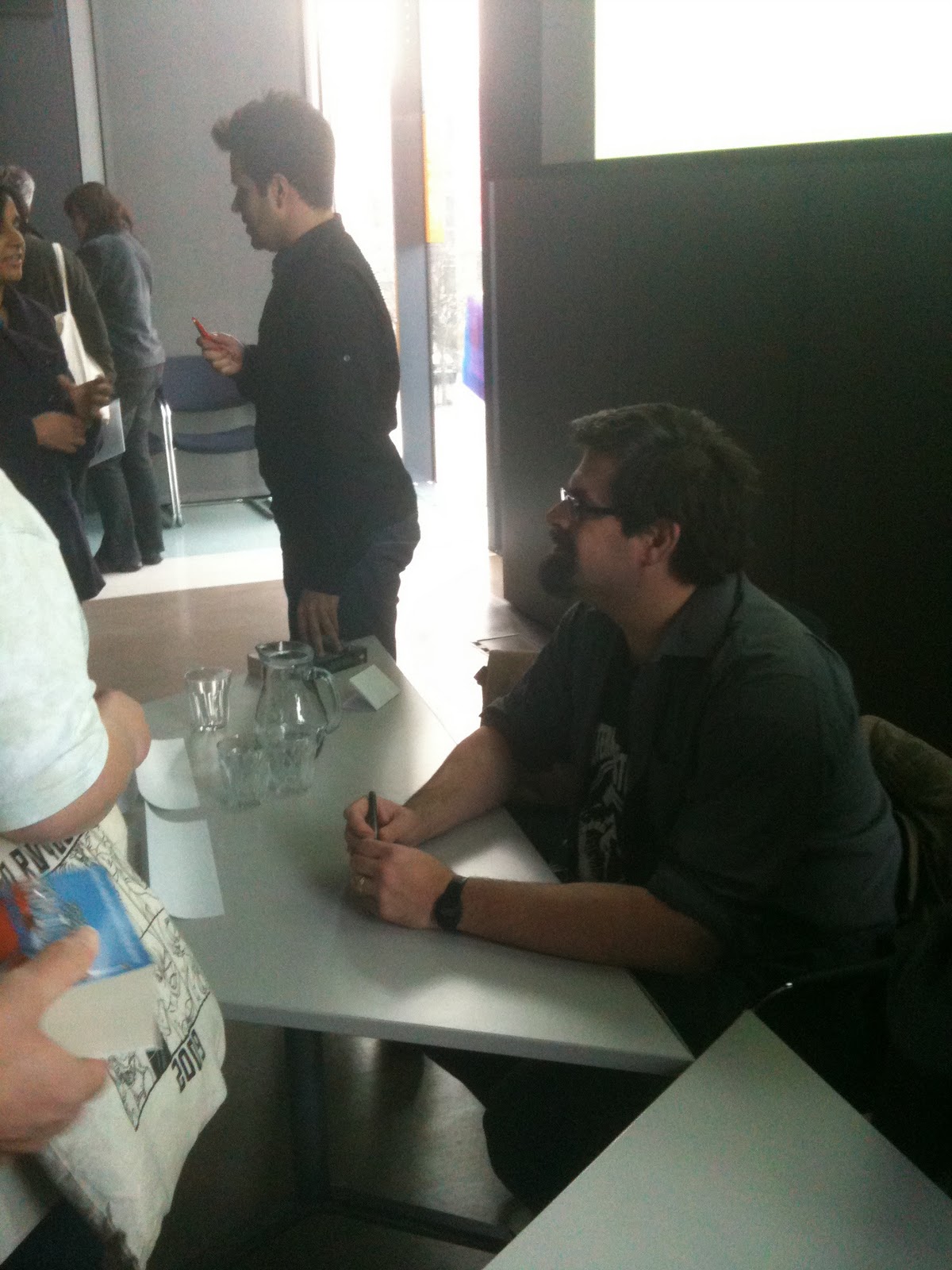
Had a fun day out in Derby today, at the Alt. Fic convention. While it is on a smaller scale to the other UK cons, it nonetheless had a number of interesting things going on and there was a respectable turn-out of writing/publishing folk.
Upon arrival, I dumped my coat in the cloakroom and made straight for the Q&A session run by Christian Dunn, the Commissioning Editor for Solaris. Many of the questions asked were ones I've seen online many times, so the answers were familiar. Still, the atmosphere was nice and informal and it was good to hear the answers coming straight from the horse's mouth, as it were.
After that I went straight to the panel discussion about publishing that included genre agent extraordinaire, John Jarrold, and George Mann, Consultant Editor for Solaris. A lively debate, with plenty of insightful (and blunt advice) from Mr Jarrold. "Writing a good book isn't enough," he deadpanned. "It has to be brilliant." Judging by the mutterings of some audience members afterwards, his words had ruffled a few feathers. I personally thought they were spot-on.
Keen to hear more from John Jarrold, I popped along to his personal Q&A session later in the afternoon. Again, most of the questions were those you see on most writing forums (I have to admit I did kinda wonder whether any of the other people at the talk actually bothered to use such forums) but it was good to hear them coming from someone with such a knowledgeable background. John Jarrold's got a fine sense of humour too, so it was a fun session.
In between panels I managed to grab a bite to eat and chat with Mark and George from Solaris, which was a pleasure, as always.
So, a long day (not to mention costly) but a good one.
Friday, 25 April 2008
Del Toro to direct The Hobbit!
Awesome news.
Thursday, 24 April 2008
New John Marco website
US author John Marco has got a tasty new website up and running, which you can check out here.
Interestingly, John reveals a little more about his Skylords trilogy:
"Not only is it a story of coming of age for the two main protagonists, Moth and his friend Fiona, but it’s also about mankind’s coming of age. The world of Starfinder is very much like our own at the turn of the last century, with steam trains and electricity and budding technologies. And thanks to the inventive genius of Fiona’s grandfather Rendor, humans have finally taken to the sky, not only in giant airships but in small, ornithopter contraptions called dragonflies as well."
Sounds very cool indeed.
On his blog, John also revealed that for his next project, he may well revisit his character Lukien, main protagonist of The Sword of Angels, The Devil's Armour and The Eyes of God. Having only read John's excellent Tyrants and Kings series, I was secretly hoping he might be revisiting the world of Nar and Lucel-Lor again, but that doesn't seem to be on the cards right now.
Still, you never know what the future may hold...
Wednesday, 23 April 2008
Giveaway! The Solaris Book of New Fantasy
Thanks to the kind chaps at Solaris, I have a shiny new copy of The Solaris Book of New Fantasy to give to one lucky winner.
My earlier review of the book is here, and you'll see that I was rather impressed.
To stand a chance of winning this enjoyable collection of short fantasy fiction, all you need to do is send an email to speculativehorizons AT googlemail DOT com (obviously substituting the necessary characters).
In the title of the email, please put "Book of New Fantasy giveaway".
And that's it. You don't need to provide your address, as I'll contact the winner to confirm those details later.
The winner will be picked at random and will be announced next Wednesday.
Good luck!