Wednesday, 11 August 2010

Quick update from Spain...

Firstly, the response to the giveaway has been wonderful; over 100 entries so far. Thanks a lot for the interest and keep the emails coming! I forgot to say in the original post when the deadline is, so let's say midnight on 18 August 2010. Given the great response to this giveaway, I may well make them a more regular feature...

As for Spain, I've had a very enjoyable time so far. Currently in the gorgeous city of Valencia, having already visited Barcelona, Madrid and Seville. Needless to say, I'll bore you all with some photos when I get back...

Quick shout-out to Adam Nevill, whose excellent book Apartment 16 has apparently done very well so far - great to hear.

Right, that's enough for now.

Catch you all soon.

Tuesday, 10 August 2010

So...who wants free books?

Thought you might.

Well as it happens, my to-read pile has grown to monstrous proportions. It's taken over my living room. What started as an innocent pile of books on my coffee table has mutated into something altogether more terrifying. Now the books have spread from my table. They're on my couch as well. Some have even made it as far as my bedroom. THEY WATCH ME WHILE I SLEEP. Soon they will consume me.

But there is hope - I've noticed a weakness in the beast's genetic make-up: some of the books are the same. If I can extract the doubles, the creature will be weakened and I might be able to fight back against the horde of unread books.

But I need your help. I need someone to take the following books off my hands:

Wolfsangel by M. D. Lachlan (ARC)

The Quantum Thief by Hannu Rajaniemi (ARC)

The Thief-Taker's Apprentice by Stephen Deas (ARC)

Dog Blood by David Moody (MMPB)

The Japanese Devil Fish Girl by Robert Rankin (ARC)

How's that sound - anyone willing to give me a chance at survival? NO?! WTF. Alright, you ungrateful lot...how about I throw in one more?

The Dervish House by Ian McDonald (ARC)

That better? Thought so. Right, all you need to do to be in with a chance of me dumping these books on you winning these books (and let's be honest, what an awesome haul it is) is send an email to the usual address (see sidebar), with the title as "OMG BEST GIVEAWAY EVAR" or something like that. No need to give me your address; I'll contact the winner and request those details later. Needless to say, the winner will be picked at random.

And yes, this giveaway is FRICKIN' GLOBAL so get emailing, wherever you are. DO IT NOW.

Good luck to you...and me. ;)

Friday, 6 August 2010

Winter Warriors - an appreciation

David Gemmell's Drenai novels are notable for their low-fantasy setting; while supernatural elements are present in them, they mostly tend to be fairly minor and rarely have a major influence on the stories. These novels are primarily about human beings, and their flaws and foibles. They are character-driven; this has always been their strength.

Winter Warriors is the black sheep of the Drenai family, because it boasts far more prevalent supernatural elements than the other novels in the series. 

The reason for this, according to rumour (I'm unsure as to whether it was ever confirmed), is that the book was not originally written as a Drenai novel; instead, it was intended as an individual title like Dark Moon, Echoes of the Great Song, Morning Star and Knights of Dark Renown. Like Winter Warriors, all of these novels feature much stronger supernatural elements than the Drenai books. However, Gemmell's publisher allegedly persuaded him to change the novel's setting on the basis that the book would achieve greater sales if it could be marketed as a Drenai novel. 

This is certainly a good explanation as to why Winter Warriors features more fantastical elements than the rest of the novels in the Drenai saga: demons and vampires, enchanted swords and prophecies abound.  

Yet like most of Gemmell's novels, the premise is simple: upon the death of three kings, a race of demons will return to take back the world that they view as theirs by right, and to take their vengeance on mankind. Two of the kings are dead, the third - an unborn child - is hunted by the terrifying Krayakin, Lords of the Undead. 

Driven from the luxurious surroundings she is used to, the pregnant queen finds herself forced to flee for her life through dark forests and over snow-capped mountains, as the demonic forces snap at her heels. 

Yet she is not alone. Protecting her are three warriors, who have been dismissed from the Drenai army because of their age: Nogusta the Swordsman, Bison the fighter, and Kebra the Bowman. Their loyalty is unquestionable, their experience invaluable, their talents almost without match. Yet they are old men; their best years are behind them. 

As their enemies close around them, one question remains - can these three aged warriors prevent the world from sliding into darkness? 

Despite these high-fantasy elements (which curiously are at odds with Gemmell's brand of low-fantasy), Winter Warriors is still very much a book where the characters take centre stage. The plot may be a little more driven by the unfolding events than many of his other books, yet his strong grasp of characterisation remains intact. 

The novel's strongest point are the three principal characters, and the dynamics of their relationships with each other; they are quintessential Gemmell heroes. All of them have flaws and personal demons that they must do battle with. Nogusta is forced to confront the horror of his past at every turn, while Bison fights a different enemy - the knowledge that age has caught up with him, and that his soldiering days are almost over. Kebra, meanwhile, struggles with his fading eyesight and the lack of discipline that characterises his newfound existence. Their personal struggles are just as enthralling as their battles against the sinister, black-armoured Krayakin, and their personalities are judged perfectly: Nogusta's nobility and Kebra's brevity combine seamlessly with Bison's affable crudeness, lending genuine depth to their friendship as well as allowing for several amusing exchanges and moments throughout the novel. 

The other characters are also well drawn, such as the young Drenai officer Diagoras, who battles self-doubt, and the arrogant Ventrian swordsman Antikas Karios, another man who must confront the darkness that lurks in his own soul. The development arc and changing personality of the queen, Axiana, is handled well, as is that of the priestess Ulmenetha. Interestingly, Gemmell also provides POVs from the demonic side of the story, and these are no less interesting than their human counterparts; the Krayakin are suitably threatening antagonists. Gemmell uses these different perspectives to explore several ideas about love and hate, revenge and redemption - themes which, as with all his books, permeate the story. 

Speaking of the story, it's gripping and rips along at a very satisfying pace. The tension is cranked up wonderfully, there are a number of intriguing twists and revelations, and just when you think you're going to get the classic Gemmell device of a battle where defenders face overwhelming odds, you end up with something rather different. As the action hots up, the line between hero and villain becomes ever more blurred.

This is the fourth time I've read Winter Warriors, yet its potency has not lessened. I'm still transfixed by the same duels, I still laugh at the same jokes, I still engage completely with these characters and their hopes and fears. Put simply, it really is utterly riveting stuff. 

I think it's the romantic undertone of the novel that speaks to me the most - the idea of three old men risking everything to save a kingdom that has cast them aside, speaks to me very deeply. 

Gemmell's best novels are hugely inspiring; the heroism in them never fails to lift my spirits. Winter Warriors is no exception. 

Wednesday, 4 August 2010

If ever there was a cover that made me want to read a book...

...then this is it.


Never mind that it's old, or that its got a crap name, or that it's a Landover novel by Terry Brooks (as opposed to his Shannara novels, the earlier ones of which I rather enjoyed). Just behold the pure awesomeness of a HUGE BLACK DRAGON brawling with a GIANT WORM-THING.

Talk about epic.

Has anyone read Witches' Brew *snicker* and, if so, does it have a truly epic smackdown featuring said participants?

Monday, 2 August 2010

Classic genre video games #4 - Golden Axe 2

Ah, Golden Axe 2 - one of the finest hack n' slash games ever made. Button-mashing at its finest. Not big, not clever, but plenty of fun. Especially when played with a friend that was as enthusiastic for battling hordes of enemies with big choppers (ahem) as you were.

This was how many of my Saturday afternoons as a youngster were spent: embarking on a perilous quest with my friend to defeat the EVIL DARK GUILD and save the land. Which had been saved in the first game, but apparently needed saving again.

There was no fighting over who got to play as which character; our choices were well defined. I always played as the male barbarian Ax Battler (who, despite his name, wielded a sword - go figure) while my friend always plumped for the dwarf Gilius Thunderhead (who, according to the box art, is possibly the buffest dwarf ever). We rarely played as Tyris Flare, though now and again one of us would pick her "because she has the best magic." The other player would nod sagely, knowing full well that the real reason the other had chosen her was because she was a hot amazonian. Come on, she is. Look at the box. In fact, is it just me or is the way she's riding that dragon rather...actually, let's just move on.


The gameplay was basic and had barely changed from the first game: mash buttons to kill enemies, repeat until no enemies left. Progress onwards, repeat process. Goggle at Tyris Flare. Mash buttons...

But for two young teenagers who had yet to discover girls (who needed a girl when you had Tyris Flare?), it was remarkably good fun. Gameplay was punctuated with squeals of geeky delight such as "Omg dude, a purple lizardman" and "Omg, look at how smashed up that portcullis is...OMG HUGE MONSTER. Quick, wind magic!" And so on.


Golden Axe 2 was far from the best game to appear on the Sega Megadrive, and certainly had plenty of flaws, such as the crap sound effects (the enemies' death groan sounded like a kid puking) and the lack of variety in the enemies (changing the colour of the sprite doesn't really count...). Yet there was something very appealing about making a ripped barbarian kick countless enemies' asses with a huge sword.

Good times. :)

Saturday, 31 July 2010

Off on my travels...

Just a quick post to say I'm off on holiday on Sunday for a couple of weeks.

Never fear though, as I've got plenty of content scheduled to appear over the coming days, so do keep checking back. There might even be some free books up for grabs...

So. See you all again soon - please don't break the interwebs while I'm gone.

:)

Friday, 30 July 2010

Some pulpy, old-school cover goodness...

...because a bit of pulp every day keeps the doctor away. Embrace the pulp! EMBRACE IT.


Thursday, 29 July 2010

Del Toro to direct film adaptation of Lovecraft's 'At the Mountains of Madness'

According to Empire:

"It’s both a shock and yet not truly surprising, as the Lovecraft tale (which sees a 1930s scientific expedition discover something ancient and terrible at the South Pole that suggests mankind’s origins might lie with the powerful, alien elder gods) has been a passion project for the filmmaker for more than 13 years.


The movie has been at more than one studio over that time, with the current incarnation starting off at DreamWorks in 2004. But that stalled out and Universal took it over when del Toro made an overall deal there in 2007. It looked like the Madness might actually begin there, before The Hobbit came a-calling and GDT headed to New Zealand.


But with Middle Earth now off the table, it’s back into the Madness for the man who has long dreamed, along with writing collaborator Matthew Robbins, of bringing the monstrous elders to life."
I must admit I'm not that familiar with Lovecraft's work, having only read a handful of his short fiction, but I've heard good things about this particular story. With James Cameron onboard to help with the 3D aspect, this is certainly one to keep an eye on.

Wednesday, 28 July 2010

Four years on...

...and David Gemmell is still hugely missed by thousands of fans around the world.

Gemmell passed away on 28 July 2006. I still remember the moment I found out, sitting at my desk at work, totally shocked. It was horrible. Still is. The fact I never got to meet him - my favourite author - is still a source of much sadness. That he did a signing in Manchester (which I was unaware of) in the months before his death only makes it harder to take - had I known, I would certainly have gone. Talk about missed opportunities. 

I've waxed lyrical about Gemmell so many times, and don't see the point in doing the same again. It will suffice to say that his books are wonderful, and never fail to raise my spirits. In fact, I just finished reading Winter Warriors for the 4th time, and it was just as good as it was the first time. Marvellous book. Look out for a post about it in the near future.

I'm not the only blogger that loves Gemmell's work - the crew over at FBC love his books as well, and have got a wonderful exclusive: a previously-unpublished excerpt that can be read as a prelude to The First Chronicles of Druss the Legend. Check it out.

I'll leave you with a quote from the man himself:
"I tend to concentrate on courage, loyalty, love and redemption. I believe in these things. If there’s anything I’d like my books to achieve, it would be to increase the desire of people to do good.”
Amen to that.  

Artwork for Elves: Rise of the TaiGethen

Here's the cover for James Barclay's second novel in his Elves series:


That's one buff elf. I like the teal-ish tint to the background, and it's a relief to see a rather less wooden caption this time around. I also like the fact that the cover unashamedly screams 'genre' nice and loud.

Tuesday, 27 July 2010

A few words on HBO's Game of Thrones adaptation

I tweeted this recently, but thought it was worth repeating here: I think HBO have done a stonking job casting this series.

It's great to see that they've not been afraid to cast unknown actors and actresses who have little to no experience of acting for TV or film. But more importantly, it's hugely encouraging to see how much effort they've put into casting the dozens of roles (I'd forgotten how big a story this is, and how many characters it involves, until I read the news of all the castings).

Wert (yep, him again) has done some great posts on the recent castings: here, here, here and here. In terms of looks, most of these actors/actresses look spot on. Only castings I'm not convinced by are Jerome Flynn as Bronn (he could certainly pass for the sellsword, but can he pull off the dark wit?) and Gethin Anthony as Renly Baratheon (he looks a bit young, though it might be an old photo). But otherwise the casting is excellent - James Cosmo as Jeor 'The Old Bear' Mormont and Aiden Gillen as Littlefinger are particularly good examples.

Such has been the excitement since the project was first revealed, even the mainstream is sitting up and taking notice: there's a piece on The Guardian website about the series:
"With feelings so high there is a danger that the show will be unable to live up to the hype. But all the signs so far are positive. It's being made by the same team that made Rome – so the BBC has a stake in the show. It's being shot mostly in Northern Ireland and the cast – including the aforementioned Bean and Lena Headey – looks great. Much fan excitement surrounded the "perfect" casting of Aidan Gillen from Queer as Folk and the Wire as machiavellian puppet master Littlefinger. (Yes, that is the second character I've described as machiavellian – it's that kind of story.) Buffy writer Jane Espenson is part of the writing team, as is Martin himself. It seems that the adaptation is going to be solid and faithful to the text – no wily re-imagining. With source material this good, that's no bad thing."
While it's cool to see the coverage the series is getting, I have to take issue with a couple of things in the article.

Firstly:
"For the uninitiated – that is, people who don't gleefully buy 600-page books from the nerd section of Waterstone's – A Game of Thrones is the first book in the A Song of Ice and Fire series."
Ah, mainstream coverage of something related to the genre wouldn't be complete without the usual snipe. Seriously, what's the point? The whole "nerd section" nonsense could have been left out of that; it's totally irrelevant. Still, we've come to expect this sort of snobbishness from the mainstream.

Also:
"A Game of Thrones is high fantasy; although with a lot more swords than sorcery. It's a world of prophecies, exiled princesses, talking crows and magical trees."
Sheesh, what a crap way of describing the series - talk about making it sound like something it's not. High fantasy? No, not really. A Song of Ice and Fire is a series in which the primary focus is on the feuding of several different families - with the focus very much on the characters; it's been described as the War of the Roses with dragons, and that's not a bad description. Certainly, the elements mentioned above are minor elements. The 'magic trees' description particularly pisses me off, as it's not really accurate. All things considered, Martin's world is relatively low-magic, so to definite it as above doesn't do it justice.

Ho hum...

Anyway, for all the latest news on the production, check out the excellent blog Winter is Coming. 

Abercrombie artwork, if you've not yet seen it...

Cover for UK version of The Heroes. And yes, I know it surfaced ages ago - hence the 'if you've not seen it yet' part.


Unsurprisingly it's in keeping with the cover for Best Served Cold - the map in the background, the weapon in the foreground, etc, though it does seem a little bare compared to its predecessor (I always liked the coins and blood on the BSC cover; lovely little detail). Still, a good cover. NO HOODED FIGURES.

While we're at it, here's the artwork for the Sub Press edition of The Blade Itself.


I really like the typeface. Not wild for the art itself, but it's an interesting new direction compared to previous covers.

Quote of the day

Courtesy of our very own Werthead:
"StarCraft II is released tomorrow. The United States defence department would not be drawn if the current naval exercises off the coast of the Korean peninsular were planned specifically to deter a North Korean invasion as millions of South Koreans skive off work to play the game, leaving the country dangerously distracted by Zerg rushes and mastering the new units."
Heh. Wert's right though; the South Koreans love their video games. Sometimes too much.

Oh, and speaking of Starcraft II - check out the awesome trailer.

Monday, 26 July 2010

Quote of the day + assorted Viriconium commentary

This quote from the Westeros forum, in a thread about M. John Harrison's wonderful Viriconium sequence, made me laugh:
"But I agree that the last story in the Viriconium collection left me feeling as if someone had tried to beat me to death with a rubber chicken."
I can understand completely where the poster is coming from; the last story in the sequence - A Young Man's Journey to Viriconium - is bizarre and hard to fathom. As is, admittedly, much of the Viriconium material, not that this stops it from being staggeringly good at times.

Anyway, the thread threw up some Viriconium essays that Larry wrote some time ago, and slipped under my radar since I'd not read Viriconium back then. The first is a very good examination of The Pastel City, the first 'novel' from the Viriconium sequence:

"As I read The Pastel City, I found myself slowing down to read and re-read almost every single paragraph. There is a richness in Harrison's prose that makes reading each sentence a pleasure. Look again at the passage quoted above. Say it aloud, listening for the rhythms. There is a music of sorts in Harrison's writing, a music that is haunting and seems to come from a place within us that isn't a discoverable, tangible country."
It's pleasing to see someone actually focus on the novel's prose, and give it the appreciation it deserves. M. John Harrison is a figure that evokes hostility in a lot of genre fans, many of whom appear to have decided - rather foolishly, in my humble opinion - that his books must be shit because he's quite outspoken about the genre: "Isn't he the dude that said worldbuilding is for nerds? OMG HE MUST BE A DICKHEAD." A comparison has even been made with Terry Goodkind, which is laughable (for many reasons, but mainly because Harrison can actually write). I just think it's a shame that so many people have missed out on Viriconium simply because they've been upset by something Harrison has said. Sure, it's not for everyone. Yes, much of it is incomprehensible. But it's also wonderful at times, and the prose is sublime. Say what you like about Harrison - and people are never shy to - but you can't deny that the guy is a wonderful wordsmith. He also makes a lot of interesting points about the nature of epic fantasy in the pages of Viriconium - check out Larry's essay for more information.

Larry's second essay, on A Storm of Wings, can be found here. My own review of Viriconium is here.

Sunday, 25 July 2010

Goodkind's 'Wizard's First Rule' gets pwned

I enjoyed this highly amusing dissection of Terry 'not very' Goodkind's Wizard's First Rule over the weekend, over at Pornokitsch.
"Wizard's First Rule is the inspiring story of Richard Cypher, who, despite being mentally-challenged, manages to eke out a living as a rustic guide in the hills of fantasy Alabama. His evil older brother picks on him a lot, but, despite the teasing and the beatings, Richard knows that he is loved.
In fact, Richard's small world is so filled with special love, that his father's horrific murder comes as shock (less so to the reader, as it occurs on page 2, before we've ever met the character). To recover, he spends his days stumbling about the hills of fantasy Alabama, grieving for a character that is completely unimportant to the reader and described in a purely functional way. On one of these wandering journeys, something new enters Richard's life: breasts.
Kahlan is the first woman to ever appear in fantasy Alabama, so when she shows up in her clingy, white, figure-hugging, completely-impractical cocktail dress and 5-inch spike heels, Richard is overcome with strange new sensations. When he first spots her, Kahlan is under attack by no less than four assassins, but, since they're all walking single file, they trip over Richard's engorged member and fall off a cliff."
Great stuff; be sure to check out the rest of the article.

Saturday, 24 July 2010

Brad Pitt to produce and star in film adaptation of 'World War Z'

From the Independent's website:
"The film rights to author Max Brooks' zombie book World War Z have been bought by Brad Pitt to be adapted for his production company Plan B, MTV reported. Pitt also plans to act in the film. The movie is planned for release during summer 2012."
This is pretty cool news. World War Z is an excellent book, although may not be easy to adapt to the big screen given that it is essentially a collection of interviews and memoirs from various survivors of the zombie outbreak. However, there's some wonderful moments in the book that will no doubt translate very well to the film medium; the battle of the US army against a million zombies at Yonkers could look pretty spectacular.

Definitely one to watch.

My review of World War Z can be found here.

Some genre funnies, news and links...

It's Saturday morning, so what better time for some genre funnies?

This Cloud Totally Looks Like The Stay Puft Marshmallow Man

Mary Murphy Totally Looks Like The Mouth of Sauron

Yoda Totally Looks Like Pope

What, you want news and links too? SO DEMANDING. But ok.

The main news of the last few days is that Steven Erikson has completed his epic ten-book Malazan Book of the Fallen series. In a brief comment posted on his facebook page - credit to Pat for glimpsing it first - Erikson wrote:

"GASP! That would be me, coming up for air. How long was I down there? About twenty years, from conception to completion. The Malazan Book of the Fallen is done. Sure, editing and all that crap to follow. But ... done. I don't know who I am. Who am I again? What planet is this? Three months of butterflies ... maybe this double whiskey will fix that. Hmm. No. Delayed reaction going on here."

Whether you're a fan or not, Erikson deserves credit for this achievement. The regularity with which he has turned out huge books is admirable. Of course, there's been some criticism - that the quality has slowly gone downhill, that there are inconsistencies with plot/character/history - but it's still a feat deserving of recognition, especially considering the delays fans have experienced waiting for new releases from other authors.

What else...oh yeah, Aidan was quick to notice that Peter Brett has sold another novella to Subterranean Press:

"Peter V. Brett sold a stand-alone novella, Brayan’s Gold, to Subterranean Press, via agent Joshua Bilmes. The volume will be “heavily illustrated by artist Lauren K. Cannon.”

Speaking of Brett, I've got a nice copy of his new novel The Desert Spear. It's sitting on my table and staring at me. And it's big. While the general reaction has been positive, there's been some interesting criticisms - notably concerning the use of rape in the book, and the character of Leesha (who, in some quarters, has been branded with the odious tag of 'Mary Sue'). I'm intrigued to see whether I feel the same way (I do recall she was a bit of a Goody-Two-Shoes in the first book at times), so hopefully will get around to The Desert Spear at some point.

Right, that'll do...what - you want more? OMG SOME LINKS FOR YOU THEN. Just a few, because I'm meant to be getting ready to go out...see what personal sacrifices I make for you lot?

The Speculative Scotsman has reviewed the year's biggest release - The Passage.

Mark has got a good write-up of the Predators movie.

Aidan's got the finished artwork for The Broken Kingdoms, N. K. Jemisin's second novel (I'm not keen on the title, too similar to the first book). The cover is really nice though.

Wert has got the
artwork for M. D. Lachlan's Fenrir, the sequel to the well-received Wolfsangel (which I still need to get around to). He's a busy little bee, is our Werthead, and he's also got a review of Ken Scholes' Lamentation.

Amanda's got a pretty epic
Black Library giveaway - go check it out. And laugh at the douchebag moaning about privacy in the comments section. If you're worried about giving your personal details away, don't enter! Honestly, some people...

My Favourite Books have
reviewed Stephen Deas' The Thief-Taker's Apprentice. 

That enough genre goodness for y'all? Good.

Thursday, 22 July 2010

Gollancz announces book deals and artwork

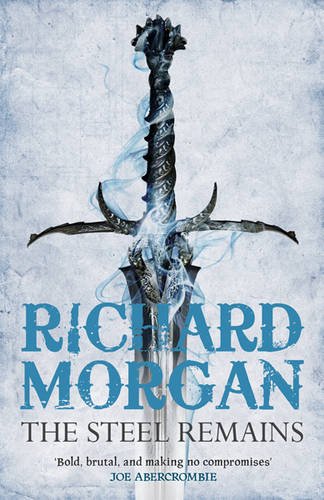
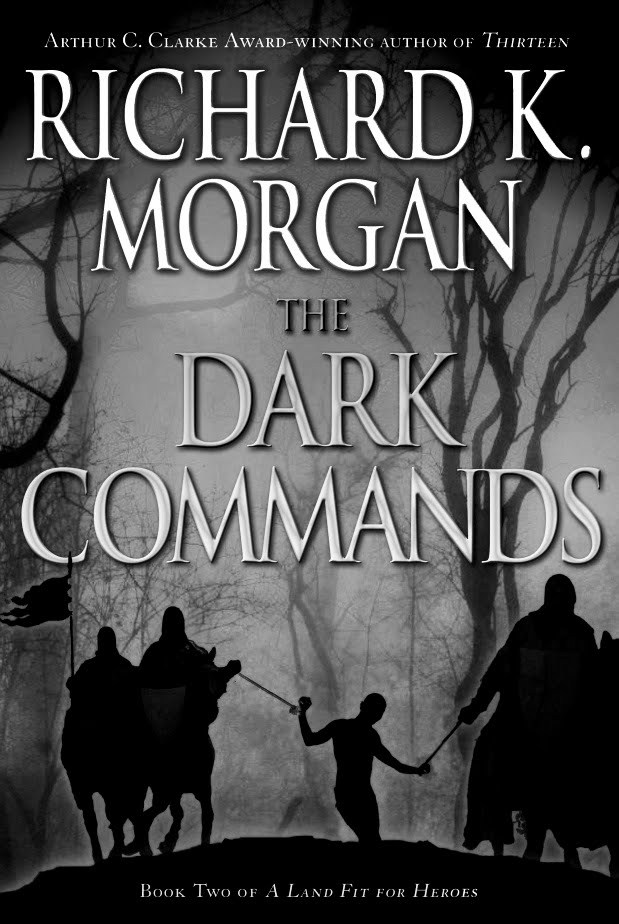
First up, the UK cover for Richard Morgan's The Cold Commands.


Interestingly, Gollancz seem to have gone for a cover that is similar in style to the UK MMPB version of The Steel Remains, rather than the original hardback cover (which I must say I prefer). By contrast, the US cover is more in keeping with the tone of the UK hardback cover, and I like it more than the above version.

Speaking of Gollancz, they had some interesting news on a couple of book deals today...

First up, Stephen Deas - author of the very successful Adamantine Palace and its follow-up The King of the Crags has set pen to paper on a new deal for more books. From the journal of agent John Jarrold:

John Jarrold has concluded a four-book World Rights deal with Simon Spanton of Gollancz, for fantasy novels by Stephen Deas, for a high five-figure sum in pounds sterling. Deas’ debut novel, a dragon fantasy titled THE ADAMANTINE PALACE, was published by Gollancz in March 2009 and followed by KING OF THE CRAGS this April (the third volume in this series, ORDER OF THE SCALES, will follow early in 2011).
The first book in this deal is a one-off, THE BLACK MAUSOLEUM, related to his dragon fantasies, which will be followed by three further adult titles that entwine that series with Deas’ YA fantasies that open with THE THIEF-TAKER’S APPRENTICE in August. THE BLACK MAUSOLEUM will be delivered in the summer of 2011, with the other books following at yearly intervals.
‘Simon and I did our first three-book deal for Steve at the end of 2007,’ said John Jarrold. ‘With the immediate success of THE ADAMANTINE PALACE in early 2009, we were able to follow that up with another three-book deal that May. And now Steve’s third multi-book deal in two-and-a-half years – which is remarkable testimony to his writing and story-telling, and to the fact that Simon and Gollancz know a good thing when they see one!’

Congratulations to both Stephen and Gollancz.

Secondly, one of those news items that no doubt lends (false) hope to the countless self-published authors out there: Gollancz have signed up a self-published author in a six-figure deal. Taken from the Bookseller:

Gollancz has spent a six figure sum in acquiring a five book young adult fantasy series that had previously been self-published.
Gillian Redfearn, senior commissioning editor, bought world rights from Pier Russell-Cobb, managing director of MediaFund, to the Stonewylde series by Kit Berry.
The first four novels in the series, Magus of Stonewylde, Moondance of Stonewylde, Solstice at Stonewylde and Shadows at Stonewylde, will be available from the Orion sci-fi and fantasy imprint next year.
Gollancz described the series as about Stonewylde, a hidden idyllic community in Dorset ruled by a Magus. The publisher said: "For Sylvie, a young girl dying in hospital, Stonewylde could be more than a paradise: it could save her life...but for all the harmony of this world, there is something dark lurking at its heart. The magic of Stonewylde could save her...but at what price?"
Redfearn said: "I'm delighted that Kit Berry has joined the Gollancz list. The Stonewylde books are a breath of fresh air, a multi-faceted series with something that will reach out to every reader, and a character to touch every heart. The Stonewylde series will bring a touch of magic to the genre...Kit herself has an amazing story as well: her success as a self-published author is amazing, there’s a wonderful tale behind how she came to write the novels – with magic, romance and a spirited battle against the publishing odds. I can’t wait to work with Kit to bring Stonewylde to a larger audience."

This is an interesting one, make no mistake, both for the amount of money involved and the fact that the author had self-published their work.

Saturday, 17 July 2010

Making and breaking worlds

Sam Sykes, author of Tome of the Undergates and Angriest Man Alive, has nailed me to a cross and raised me up as a banner in his new post on worldbuilding (and there was me thinking I felt rough this morning due to last night's alcohol intake).

It's an interesting post, which asks how the question "how are authors meant to go about worldbuilding?"
"We’ve seen excellent examples of it. George R.R. Martin’s A Song of Ice and Fire is set in the midst of high-rolling, power-playing nobles with grudges and ambitions that affect the whole world and this lends it an excellent reason to explore the vast and detailed world he’s created. Scott Lynch’s The Lies of Locke Lamora revolves around a city that’s basically its own character, and we’re just as happy to know it as we are to know Locke and Jean.
And we’ve also seen poorer examples. Some people will decry The Wheel of Time series for its encyclopedic references to things that don’t affect the story (while others embrace the series just for that). And there’s always going to be those who point to a new book and say: “He’s no Tolkien.”
Worldbuilding can be quite a divisive topic in the online genre community - you only have to look at the fall-out from M. John Harrison's infamous "clomping foot of nerdism" dismissal to see that.

I'm not interested here in discussing the importance of it all, as that topic has been done to death. I just thought I'd give some brief thoughts on what I like to see in a novel in terms of worldbuilding.

Despite often calling some authors' worlds bland and derivative, I'm not looking for something utterly mind-blowing and unique (which is just as well, because you very rarely see examples of that). But I do like to see something a little bit different, because after all there's no real limits with fantasy and it's nice to see authors taking advantage of this. Yet at the same time I like a world to have a certain degree of familiarity - I don't want it to be so unusual that I'm struggling to put it in context or understand it (because that then can detract from my enjoyment of the novel).

This reasoning - my desire for a world that feels familiar, yet fresh at the same time - explains why I like the worlds that feature in John Marco's Tyrants and Kings trilogy, Adrian Tchaikovsky's Shadows of the Apt series, and Mark Charan Newton's Legends of the Red Sun series.

Marco took a familiar world of knights and castles, but threw flame-throwers and acid-launchers into the mix. He made his capital city an industrial hellhole where smoke billows from the chimneys of countless factories that are constantly developing new war machines. The result is that intriguing mix of the familiar and fresh that I'm looking for. His trilogy is unmistakably epic fantasy, just with a different sheen.

The same sort of balance has been achieved by Tchaikovsky and Newton: both have created worlds that on the surface appear familiar, yet scratch beneath that and you find something a little different (people with insect characteristics and abilities in Tchaikovsky's case, a dying world of misunderstood technology and bizarre creatures in Newton's).

The application is just as important as the end product. I don't want to be bombarded with countless names and references to the world's history, as without some sort of context they're meaningless. Sentences like "The palace was an exquisite fusion of architectural styles: turrets from REGION X, battlements reminiscent of PLACE Y, and spires in the image of LOCATION Z" just don't work effectively if there's been no previous mention of these places. You can't evoke a sense of place just by pulling names out of a hat. It's a cheap, unsubtle way of saying, "Hey, my world is really big and has all these exotic places in it." Yeah? Well tossing names about isn't really demonstrating that.

The old adage of "show, don't tell," to my mind is far more pertinent to worldbuilding than characterisation. I want to see the world through the eyes of the characters, not be told about it in long passages of exposition. I think the best worldbuilding is achieved through little glimpses and minor touches, rather than chunks of exposition.

Look at this example:

At some distance on, he passed the disaggregated body of one of his Night Guard - and could tell it was Voren by the elaborate bow cast to one side. Doglike black gheels lingered around the corpse, their triple tongues and double sets of eyes shifting in rhythmic twitches around the wound, in a ritual as old as the land itself. 

The above snippet is from Mark Charan Newton's Nights of Villjamur. Look at how there's no needless exposition. Newton doesn't bash the reader over the head with unnecessary information about the gheels: what they are, where they come from, and so on. We just see them. They just happen. And in three lines Newton's shown us a glimpse of his world and given it a shade of intrigue.

Now look at this example:

Suddenly I heard a menacing growl behind me...I turned my head and there was a garrinch, devouring me with the insane glare of its white eyes. 
Garrinches live far away in the south, in the Steppes of Ungava, almost on the borders of the hot Sultante. The creatures are magnificent watchdogs, especially useful against lads like me. Getting hold of a live garrinch cub is incredibly difficult, almost impossible, because the price is simply sky-high. They say the king's treasure house is guarded by two of the beasts. 
What a garrinch resembles most of all is a huge rat, the size of a well-fattened calf, covered with snakes' scales instead of fur, with a magnificent set of teeth that can saw straight through a knight in armour, and two white gimlets for eyes. Killing one is extremely difficult - unless, of course, you happen to be a magician. 
The ceature snorted and stared alertly...

That snippet is from Alexey Pehov's Shadow Prowler. It's the polar opposite of Newton's approach: Pehov reels of a load of tripe about where the creatures come from, how hard they are to kill, what they look like, and so on. Who cares? I don't. Anyway, much of this information could be made apparent by the character's confrontation with the beast - showing us, rather than telling us. Worse, he throws a couple of meaningless place names into the mix. Worse still, the long passage of dull exposition breaks the tension of the scene; the worldbuilding gets in the way of the story, and that just can't be allowed to happen.

A little bit of subtlety goes a long way.

This was meant to be a brief post and somehow it's morphed into a bit of a monster. Oh well. I guess what I'm trying to say is that I consider good worldbuilding to be where an author mixes intrigue and freshness with familiarity, and reveals the depth and dynamics of their world in glimpses rather than regurgitating chunks of their world's history that they've ripped straight from their notes. And perhaps most importantly, reveals their world without interrupting the story. Because ultimately the story should be about people, not the world they're in, although they do of course have a symbiotic relationship.

Friday, 16 July 2010

Book review: Tome of the Undergates

Tome of the Undergates

By Sam Sykes

(Gollancz, 15 April 2010)

Tome of the Undergates does not open with a 200-page battle scene - let's get that clear right from the start. It's a criticism and accusation I've seen levelled at the novel in various reviews, and it's misleading. Yes, the book opens with a pretty huge brawl that only gets bigger as it progresses. Yes, the duration of the battle does last for around 200 or so pages. But it's not 200 pages of pure carnage; the battle ebbs and flows, with various breaks where other events unfold, and at times the battle rages in the background while scenes of rather different natures play out.

It might seem strange to start this review by making the above distinction, but I feel it's important the point is made - debut authors have a tough enough time as it is without having to sit there and helplessly watch as inaccurate statements about their novel are bandied around the interwebs.

The other primary criticism I've seen levelled at Tome of the Undergates - that its characters bicker and snipe at each other incessantly, to the point that it becomes tiresome - is much harder to face down, mainly because it's largely true. The first part at least: whether the constant arguing becomes tiresome is down to personal opinion.

There's no doubt that Sykes has created quite a colourful bunch of misfits - and misfits is exactly what they are: a small, silver-haired swordsman that hears voices; a snarling, wild Shict (think a female elf pumped full of steroids and you're halfway there), a red-skinned dragonman with a hedonistic lust for violence; a wise-talking rogue of dubious loyalty and even more dubious courage; a scrawny wizard with an alarming habit of setting people on fire (accidentally, much of the time), and a pious, slightly snobbish healer who can't help feel she should drop her bandages, pick up a sword and kick some ass like the rest of her companions.

Such a diverse group of individuals, with their various prejudices, beliefs and abilities, should be the driving force of the novel - and for much of the time they are. There's no doubt that when they're fighting (the enemy, as opposed to each other) they're capable of dealing out some serious damage, and their diverse natures create plenty of scope for the sniping and bickering that constantly breaks out between them, allowing for a number of amusing moments.

Yet the problem is that their backgrounds just aren't explored nearly enough to engage the reader's interest and empathy. There are hints here and there - flashes of traumatic events in their respective pasts that have set them on this adventuring road - but it's just not enough to build them into the three-dimensional figures they need to be. Fortunately the last fifty or so pages of the book goes some way towards rectifying this, but by then it's a little too late. The result is that - for all their dynamism and distinctiveness - for much of the book some of the characters feel a little hollow. Of course, Tome is the first novel in a series, so we can't expect every single revelation to be spilled. But a lot more was needed in this first installment. And with more regularity as well: having one brief glimpse at a backstory in the first third, then having a more significant one at the end isn't enough, and detracts from the desired emotional effect.

That's not to say that Sykes' charactersation is bad, as it's not. As mentioned, the protagonists are distinctive individuals, and he builds some believable relationships between them: the dynamic that exists between Lenk and Kataria is particularly well-wrought. But in the same way their backstories are reduced to unsatisfying glimpses, the same is often true of the characters' traits. Denaos has a lovely wit about him - and, you sense, a hint of self-loathing - but we don't see either of them often enough. Likewise, Gariath - who spends most of the novel rampaging about and cracking skulls - displays a quite poignant sense of anguish in the book's closing chapters, that adds a totally different dimension to his character. It's just a shame we didn't see a bit more of this facet to his personality throughout the book. An attempt is made to explore Asper's sense of inadequacy, and proves mostly unsuccessful until a major revelation is revealed without much prior warning - the result being pleasingly enlightening, if rather clumsily handled. Other characters however - Dreadaleon being the chief culprit - feel rather underdeveloped.

Another problem is the setting: the first 450 pages of the novel take place on a ship and then an island. With many novels, the scene changes with the POV character. But as Sykes' POV characters are all in the same place, it means there's no variety in the scenery. Subsequently, no matter how hot the action gets, it starts to feel rather stale at times - too much exposure to the same environment.

This problem isn't helped by the rather linear plot, which sees the adventurers setting off to retrieve an artifact that was stolen from their employer. It's a storyline that goes from A to B to C without much deviation, and the lack of a subplot is at times rather glaringly obvious. There's no shortage of action, yet this in itself is often a problem: the lack of intrigue and depth sometimes makes it a bit of a slog at times, a problem made worse by some rather protracted dialogue and the regular backbiting between the companions (which for the most part I didn't have an issue with, and actually found amusing at times, though admittedly it did grate eventually). The novel's pace also sags in the middle third, which doesn't help matters.

The element that surprised me the most was the humour - or rather, the way it often didn't hit the target. I follow Sam Sykes on Twitter, and he's funny. Very funny. And this sense of humour certainly manifests itself in Tome of the Undergates - there are some very amusing one-liners, and some entertaining scenes. But like the characterisation and plot, it's just too inconsistent. Too often the attempts at humour fall flat, which is a real shame.

Yet despite all the above, there's something likable about Tome of the Undergates, and plenty of reasons why this is so.

For a start, Sykes can write good battle scenes - he has an eye for detail and a penchant for the dramatic, and uses both to admirable effect. His prose is perfect for the type of story he's telling, being both swift and precise. While worldbuilding as a whole is on the light side, the elements that Sykes does focus on are handled well, and are very intriguing in their oceanic nature. There's plenty of cool monsters too - most notably the Abysmyths, for which Sykes researched marine life and biology. His efforts paid off.

The most pleasing aspect of the novel is easily the final third, when a new faction enters the fray and the action really hots up. These newcomers add some vital depth to the story; it's the first indication that Sykes has clearly got something much bigger in mind than the linear story that dominates much of the first two-thirds of this book. The netherlings are a striking race with a curious hierarchy, and their involvement in events bodes well for the next installment in the Aeons' Gate series.

Verdict: Tome of the Undergates is a flawed diamond. A very flawed diamond. There are numerous issues with characterisation, pacing and plotting. At times it feels hollow, at others it feels uncomfortable bloated. Yet there are enough signs to confirm that Sykes has potential. The battles are handled well, the mythology and creatures of his world are intriguing, and the more positive elements of his characterisation - the dynamics that define the relationship between Lenk and Kataria, and the flashes of depth in many of his protagonists that we see towards the end - are very promising. As is the ending, which hints that there's a lot more to come from Sykes. If he can refine his characters (lessen the backbiting, sharpen the humour, and develop their backstories) and conjure up a more dynamic plot with more depth, then he  could well be on to a winner.