The premise sounds really interesting though - I can't think of another fantasy book that focuses entirely on a single battle over a period of a few days. Really intrigued to see how this one turns out.
Thursday, 27 August 2009
Abercrombie announces next novel - 'The Heroes'
The premise sounds really interesting though - I can't think of another fantasy book that focuses entirely on a single battle over a period of a few days. Really intrigued to see how this one turns out.
My own 'Seven Essential Second-Step Fantasies' list...
What follows is a list of seven fantasy novels that I would recommend to people who want to dive into fantasy, having read only the likes of Lord of the Rings, Harry Potter, or - dare I say it for fear of my tongue withering and falling off - Eragon. Note that this is not a list of the best fantasy novels out there, but those novels that I think would be a solid, accessible introduction to the genre for relative newcomers. I've also made my choices on the assumption that different newcomers will have different reading backgrounds, while some might even have more specific ideas as to what sort of book they want to read in the fantasy genre, so I've tried to make my list as versatile as possible.
So, here we go...
A Game of Thrones by George R. R. MartinThis is an absolute no-brainer as far as I'm concerned, and its absence from The New Yorker's list bordered on scandalous. This will always be the first book I'd recommend to anyone looking to dip their toes into epic fantasy. Why? Because - apart from being the gripping first instalment in the best epic fantasy series every written - it is not going to scare away readers unfamiliar with the genre, as the knights-and-castles setting is surely familiar to everyone. Plus it's not too slow at the start - after the terrific prologue, events quickly gain momentum.
Aside from its brilliance, A Game of Thrones is a very good example of the direction that epic fantasy has been heading in recent years - moving away from the cushy, conservative farmboys-on-quests premise and into darker, more realistic territory. I actually recommended A Game of Thrones to my brother, whose experience of fantasy was limited to Tolkien and a few David Gemmell novels. He loved it and devoured the rest of the A Song of Ice and Fire series very swiftly, which was pretty impressive given that he's not much of a reader. I therefore think that this is a very good starting place for newcomers. In fact, the only possible negative is that it might actually be too good an introduction, as afterwards other epic fantasy might not compare...
A Cavern of Black Ice by J. V. JonesI was no fan of Jones's The Baker's Boy, but with her second series Jones consciously moved away from the more traditional fare of her debut trilogy. A Cavern of Black Ice - book one in the Sword of Shadows series - is right up there with the very best of epic fantasy. It's representative of epic fantasy's more recent trends in that it's often dark and brutal, but at the same time it retains a few ties to the sub-genre's traditional past, meaning that it achieves the difficult balance of catering for both those readers who fancy something a bit more hard and visceral, but also those who prefer not to venture too far from their comfort zones.
A genre newcomer picking this up will find an accessible, superbly written story in an absorbing world, full of well-drawn characters. I think A Game of Thrones is a better starting point for epic fantasy, but if the person in question perhaps wants a little more of a traditional flavour than you might find in A Game of Thrones, then this might be more to their tastes.
Magician by Raymond E. FeistWhile not representative of epic fantasy's current trends, Magician nonetheless remains a classic of the subgenre. This is the 'safe' option, and the book I'd recommend if someone said to me "I really liked Lord of the Rings and would like to read more epic fantasy, but something more like Tolkien as opposed to all this blood-and-guts stuff."
Admittedly there's no shortage of options for the newcomer who hankers after something more conservative - Terry Brooks, Tad Williams, Robin Hobb and Robert Jordan are all possibilities - but personally I think Magician is the best bet. It owes a lot to Tolkien (it features elves, dwarves and so on) but at the same time it does veer off in a different direction - whereas the likes of Brooks, Jordan and Williams all wrote novels that featured some form of 'dark lord', Feist shied away from that. Instead, Magician focuses on the arrival of a civilisation of humans from another dimension, and the subsequent war that ensues between the inhabitants of Midkemia and the invaders from Kelewan.
Magician is suitably epic and engrossing, and should prove easily accessible for newcomers. I would warn said newcomers though that this novel is by far and away Feist's best work, and that his career - in terms of quality output - has been on the slide ever since (although he did write some other decent novels, such as the four books in the Serpentwar Saga).
The Lies of Locke Lamora by Scott Lynch
This is one of my all-time genre favourites; I've read it twice and loved it both times. It was one of those few books that I actually tried to find time to read outside of my normal reading time. I'd recommend it to a genre newcomer for three reasons: firstly, it's a good indicator of the 'gritty' approach that many more recent authors have started taking in their work, secondly the setting of Camorr is very reminiscent of Venice, making it both familiar and accessible, and lastly because it's just a very, very entertaining read. On top of that, it's a stirling example of the urban fantasy genre, proving that fantasy is not just about dark lords, dragons and epic battles.
I would add the caveat that the follow-up, Red Seas Under Red Skies, is disappointing. The Republic of Thieves - when it's finally released - will hopefully prove which of the first two books in this series is representative of Scott Lynch's ability.
The Scar by China MiévilleThis is a bit of a wildcard, since it is hard to classify - I don't even know what I'd call it. What is certain though, is that The Scar is an excellent example of what you can do with the fantasy genre. Miéville shies away from cliché, proving that you don't need to rely on well-trodden tropes to write a decent book. This novel really is a triumph for innovation and imagination over the conservatism and commercialism that often drags the genre down.
It's a book I'd recommend to genre newcomers with caution, as it's not as accessible as the other titles on this list. Nonetheless, I feel it's worth including because it's such a great example of the genre's potential...and also because it's a terrific story, with well-developed characters, impressive innovations and absolutely sublime prose.
Temeraire by Naomi NovikThis is my recommendation for anyone wanting to delve into historical fantasy, because it's a good example of someone getting the balance absolutely right: Napoleonic war + dragons = winning combination (and hundreds of thousands of books sold).
Temeraire isn't the best book in the series (that honour goes to the excellent Black Powder War) but it's an engaging enough start, and again has the all-important attribute of being very easy to get into. The style of prose may annoy some readers, but it's hard not to be charmed by Novik's dragons.
The Terror by Dan SimmonsI can already hear the dissenting voices - "What? But The Terror is horror, not fantasy!" Well, yes I suppose it technically is - it is after all an utterly horrific story. Yet - in addition to the fact that you can argue that horror is merely a subgenre of fantasy rather than a primary genre in its own right - the novel features a supernatural man-eating monster than may or may not be related to Eskimo mythology, so that counts as fantasy as far as I'm concerned.
Anyway, dubiousness of this novel's validity for this list aside, The Terror is a novel I'd recommend anyone coming to the genre from a historical reading background. For a start, it's very authentic - Simmons gets the 'feel' of the period absolutely right. On top of that, he really gets inside the minds of the main characters and it's engrossing to watch them slowly unravelling. Add to this some excellent prose - I love the way Crozier's chapters are all written in the present tense - and the ever-present threat of the beast on the ice, and it comes together to form one of the best novels I've ever read. A real masterpiece. The only negative I can think of in terms of its suitability for a newcomer is its sheer size - it's a real beast of a book.
So...that's my list. I think it's more representative of the genre than The New Yorker list, as I've included three epic fantasies (representing the opposite ends of the sub-genre, and the middle ground as well), an urban fantasy, two historical fantasies and a what-the-hell-do-you-call-this fantasy. Some good variety there, I think. Some fans will no doubt look at my list and think there are some glaring oversights, so here's some of the more obvious novels/authors missing from the list and my explanation for not including them.
The Blade Itself, by Joe Abercrombie - like my fellow bloggers Aidan and Wert, I think Joe's material is more effective if you're already more familiar with the epic fantasy genre. Many of the trope inversions would be lost on someone unfamiliar with the genre's more traditional trappings.
The Name of the Wind, by Patrick Rothfuss - I've not read it, so can't recommend it!
Anything by David Gemmell - leaving Gemmell off my list caused me a bit of a headache, but I decided to leave him off as I couldn't think which of his books to best recommend to a genre newcomer. Legend? Great story but I'd be worried the often-clumsy prose might be a stumbling block. Waylander? Possibly the safest bet, but for some reason I remained unconvinced. Sword in the Storm? Better prose, but not up with the best of Gemmell's novels for me. Anyway, in the end I decided not to include him. Though if I was recommending ten rather than seven books, I think he'd make it on to the list.
Anything by Terry Brooks, Tad Williams, Robin Hobb - I don't think you need more than two traditional-ish fantasies on the list, and Feist and Jones are superior choices in my opinion.
Anything by Terry Goodkind - you're joking, aren't you? His books might be hugely popular (for a reason I don't think anyone has yet figured out) but I wouldn't recommend his books to anyone, especially a newcomer, in case they got the idea that every fantasy author was obsessed with rape and sex, and prone to spouting philosophical nonsense instead of actually telling a story...
Anything by Guy Gavriel Kay - again, not read any of Kay's work so can't recommend him.
Phew, that's it. Comments and criticisms welcome!
Monday, 24 August 2009
Artwork for Adrian Tchaikovsky's 'Salute the Dark'

Not convinced about the red font, but I love the rest. It's in keeping with the other covers in the series, yet manages to look completely different at the same time. The figure - I think it might be the moth-kinden Acheos (sp?) - is very well drawn, and the mystical red light makes the whole image very striking. Plus, if we're talking business, it's suitably commercial for the market.
Impressive stuff, and further proof that Tor were right to ditch the original artist that did the (average) cover for Empire in Black and Gold, as the covers supplied for the subsequent books by the new artist have been excellent.
Sunday, 23 August 2009
Video trailer for Andy Remic's upcoming novel 'Kell's Legend'
Wednesday, 19 August 2009
My thoughts on 'The New Yorker' essential fantasy list...
With the online genre scene being as passionate as it is, it was no surprise that not long after The New Yorker published a list of fantasy books recommended for genre newbies, the merits of said list were already being discussed across the blogosphere. I thought I might as well weigh in with my two cents.I'll go through the list book by book below, but first my overall thoughts: while it's good that such a publication is even bothering to feature an article on fantasy, the list itself is one-dimensional (all the listed novels - save perhaps for Kay? - are epic fantasy), conservative (Williams, Brooks, Hobb and Goodkind are rather middle-of-the-road) and not particularly representative of the current epic fantasy climate, let alone fantasy as a whole (unsurprising given that five of the novels were published in the nineties).
Here's my thoughts on each novel in terms of its merits as a starting point for genre newcomers.
1) The Dragonbone Chair by Tad Williams
Not a good starting point for a fantasy newbie as far as I'm concerned. It's plodding, overblown and the prose is marred by pointless similes. The endless songs are also annoying (songs in epic fantasy novels are invariably crap, unless you're GRRM or J. R. R. Tolkien). Still, the book (and series) does have its fans, although its only redeeming quality in my eyes is the fact that it inspired GRRM to write ASOIAF. Still, I guess a genre newcomer could do worse...
2) Anything by Guy Gavriel Kay
Ah, we come to a glaring gap in my genre reading. I've never read a single Kay novel, so can't comment on his suitability as a starting point for newcomers. However, I've heard many good things about his work and suspect that he might well be a decent starting point, especially as he's allegedly written a number of stand-alone books that won't require a big commitment.
3) Wizard's First Rule by Terry Goodkind
I've read three of Goodkind's Sword of Truth novels (I was young and foolish, you understand) and didn't think an awful lot of them, but never actually read the first book in the series, Wizard's First Rule. To put it bluntly, I wouldn't recommend Terry Goodkind's books to anyone, let alone a person new to fantasy. The article goes on to say: "Sadly, Goodkind did so well on this completely self-contained fantasy that he wrote ten sequels, each one worse than the one before and more prone to excruciatingly long Ayn Randian monologues from the main characters (needless to say, I read them all). Read this book, and then pretend the others don’t exist." Enough said, I think.
4) Assassin's Apprentice by Robin Hobb
I've never read any of Hobb's novels and have not really felt the urge to do so. From what I gather, her earlier work is quite traditional (although meant to be rather good). Subsequently, I can't really say whether this would be a good starting point - anyone care to enlighten me?
5) The Scions of Shannara by Terry Brooks
Admittedly Terry Brooks was my first taste of epic fantasy, yet I wouldn't recommend this book as a starting point in the genre. Why? Firstly, The Scions of Shannara - in my opinion - is not as good as his first three novels in the Shannara sequence. If you want to read Brooks, start with the excellent Elfstones of Shannara. Secondly, epic fantasy has moved on a bit since Terry Brooks was first published. By today's standards, his earlier books come across as conservative and rather cushy, so I don't think - despite reading and enjoying many of his books - that I'd recommend them to someone who wanted to see what epic fantasy is all about.
6) The Name of the Wind by Patrick Rothfuss
This remains a glaring gap in my genre reading, which I intend to remedy soon. Still, based on the fact that it's been probably the biggest success story in the genre in the last few years - and received plenty of accolades in the process - I imagine it's a decent starting point for genre newcomers, though again it's perhaps not representative of the direction the genre is taking...
7) Gardens of the Moon by Steven Erikson
Now, this is a difficult one. Personally I love this novel, but my main concern is that even seasoned fantasy fans have struggled with it, such is its chaotic nature. I rather suspect that giving this book to someone who has never read epic fantasy might be the literary equivalent of stripping someone down, smearing them in blood and throwing them into shark-infested waters. Then again, I guess it depends entirely on what sort of reading background the genre newcomer has - if they've read some historical novels with large casts, then perhaps they might be able to handle Erikson. I certainly think Gardens of the Moon is a far better example of the genre than many of the other suggestions.
Anyway, those are my opinions...as always, feel more than welcome to give your own thoughts. I might post my own list of suggestions for genre newbies in the next few days...
In the meantime, check out the thoughts of other bloggers/commentators here, here, here and here.
Tuesday, 18 August 2009
In your face, Goodkind!
How dare you give I, Ming the Merciless, a B minus?!
"If it takes a while for Alex — and the reader — to understand what's going on, it's because the writing is blocky and strained, especially during the high-octane scenes of carnage that occur every few pages. (Alex, an artist by trade, quickly morphs into an efficient killing machine.) Despite the rollicking plot, Goodkind just doesn't seem nearly as comfortable in the straight-thriller vein as he does with fantasy."
Hear that, Tairy? The reviewer said you write fantasy. Now you're going to have to get - what's the phrase? - medieval on his ass. Here's a tip - if you want the guy to suffer, tie him to a chair and read him the longest 'holier-than-thou' speech that you can find in any of your books. It might take you some time though, as there are plenty of them in there. I'd help you if I could, but I burned my first three Sword of Truth novels, and used the other one as emergency toilet paper.
No, hold on Tairy - there's more!
"So has Goodkind managed to hook all those nonfantasy readers for a sequel that looks sure to come? That's the million-dollar question. From all indications, it looks like it will take place on Goodkind's home turf, the purely imagined world of another planet."
Hear that, Tairy? HEAR THAT?! Home turf. You're one of us whether you like it or not. Don't worry, we don't bite - as long as you don't insult us by saying that anyone that doesn't like your work is a negative person intent only on destroying things. Oh, wait...
No shit, Sherlock...
Their conclusion?
"It's imperative that zombies are dealt with quickly or else... we are all in a great deal of trouble."
Well, thanks for that amazing insight - never would have realised that myself. That's not all though, as the 'scientists' made a startling, mind-blowing discovery: "Zombies can come back to life."
OMG BET YOU DIDN'T KNOW THAT. If only they'd dropped me a line - I could have told them the above points and saved them a lot of money and trouble.
Seriously, do these people have nothing better to do than state the bleeding obvious? Like, for example, trying to find a cure for cancer or something?
Saturday, 15 August 2009
Cover art and blurb for 'Farlander' by Col Buchanan
Saw the artwork for this over at Walker of Worlds, so in the friendly spirit of the blogosphere I decided to steal it and post it here, along with the blurb:"The Heart of the World is a land in strife. For fifty years the Holy Empire of Mann, an empire and religion born from a nihilistic urban cult, has been conquering nation after nation. Their leader, Holy Matriarch Sasheen, ruthlessly maintains control through her Diplomats, priests trained as subtle predators.
The Mercian Free Ports are the only confederacy yet to fall. Their only land link to the southern continent, a long and narrow isthmus, is protected by the city of Bar-Khos. For ten years now, the great southern walls of Bar-Khos have been besieged by the Imperial Fourth Army. Ash is a member of an elite group of assassins, the R shun - who offer protection through the threat of vendetta.
Forced by his ailing health to take on an apprentice, he chooses Nico, a young man living in the besieged city of Bar-Khos. At the time, Nico is hungry, desperate, and alone in a city that finds itself teetering on the brink. When the Holy Matriarch's son deliberately murders a woman under the protection of the R shun; he forces the sect to seek his life in retribution.
As Ash and his young apprentice set out to fulfil the R shun orders - their journey takes them into the heart of the conflict between the Empire and the Free Ports ...into bloodshed and death."
Nice cover, reminds me of the new Erikson ones. The blurb too is Erikson-esque as well. Doesn't seem to promise anything particularly fresh, but it sounds decent enough. Judging by Tor editor Julie Crisp's comments on her Twitter page (sigh...why is everything on Twitter these days...) she's pretty excited by this debut novel.
Farlander is set for release in hardback from Tor on 5 March 2010.
Friday, 14 August 2009
Friday funny + linky-links
And now linky-links :)
No doubt as to what has caused the most fuss this week - John C. Wright's (no, I hadn't heard of him either) pathetic rant about homosexuality. In short, it's disgusting. Not only are his views utterly repulsive, but as an up-and-coming author (he's only been around for a few years) he's displayed a pig-headed ignorance not seen since David Bilsborough managed to piss off the entire online genre community a few years back. Hopefully Wright's career will go into a nose-dive from here on - I certainly won't be reading any of his work. Unsurprisingly, Wert has already written a typically well-considered post on this distasteful matter...
Moving on to more positive things...
Orbit publisher Tim Holman has got a new blog in which he discusses the industry. Well worth checking out, as it's always interesting to get an inside look at what goes on behind closed doors...his latest post concerns what elements made up fantasy book covers in 2008.
Pat has been fortunate enough to spend some time with GRRM, and has blogged about this - and more - in the first part of his Worldcon report. Pat's also reported on Blake Charlton's Spellwright, which he suggests could be the debut fantasy novel of 2010. Personally the blurb leaves me unconvinced - some interesting ideas in there, but also some rather tired clichés...
If you missed Wert's excellent rant on the many Dune spin-offs, then be sure to check it out.
Aidan's got the artwork and synopsis for Lev Grossman's Magicians, which has received some high praise. Grossman's publisher was kind enough to offer me a copy, so I've got this one lined up for the near future. Sounds promising. Aidan's also got the synopsis for Guy Gavriel Kay's upcoming novel Under Heaven.
Neth has reviewed George Mann's The Affinity Bridge, which has been knocking around my spare bedroom for a while...must get around to it at some point...
Mark's posted the artwork for another upcoming novel, Farlander by Col Buchanan. Nice, reminiscent of the new Erikson covers...
Right, that's enough for now...hope you all have a good weekend. :)
Wednesday, 12 August 2009
Is The Wheel of Time going to go the same way as Dune?
Not content with milking A Memory of Light for all it's worth, there are now mutterings that Tor are considering expanding the WoT series with some further novels that are separate from the main sequence.Robert Jordan allegedly signed a contract for three prequels, of which only the first - New Spring - has been written and published. He also started discussing the possibility of a sequence called The Outriggers which would continue some major developments after the main WoT sequence had ended. So, we're looking at potentially two further prequels and any number of sequels to the original series.
I'm no fan of WoT, but this doesn't sit well with me. Getting Brandon Sanderson to write A Memory of Light based on Jordan's detailed notes is one thing, but writing a whole slew of new novels - presumably without such detailed notes - is completely different. To be blunt, it has the unmistakable whiff of dead horse about it and gives the impression that Tor are prepared to squeeze every last drop out of their star franchise, even if it means tarnishing the series' reputation even further.
Yes, publishing is a business - I get it. We hear this time and time again. I accept it. But it's a shame to see such a popular series be so exploited. No doubt there'll be a load of 'we're doing this for the fans' malarkey, but I wonder how much weight such statements will carry with a fanbase that has already voiced protest at the splitting of A Memory of Light into three volumes.
Perhaps a more pertinent question - how many of the fans actually want these novels? Correct me if I'm wrong, but New Dawn - the one prequel that Jordan did write - received a very lukewarm response and sold poorly compared to the main books. Will the new novels - if they are commissioned - go down any better? The decision to get Sanderson to finish WoT was not met with universal approval, so how will objecting fans feel if he writes more novels in the same universe? For the record Sanderson has already stated that he will write the two other prequels and the Outriggers novels, if asked.
No blame for this possible expansion beyond the original series can be laid at Sanderson's door - he's made his feelings clear: "I don't want to see the Wheel of Time turn into an eternal franchise. I said this last weekend at my signing in Montreal. Part of the value of a great work of art is, in my opinion, the ending. An ending loses power if it isn’t allowed to be…well, the END." He qualifies this by adding, "I have told Harriet, and I have repeated it on blogs, that I would say no (though it would hurt to do so) if a decision were made to go beyond the Outriggers and the prequels." Top bloke, Brandon Sanderson.
The fear remains though that - if these new novels are written and published, and if they sell well enough - future volumes could be commissioned with a different author if Sanderson sticks to his guns. The question then would be - what will happen to the integrity of one of fantasy's best-loved series? Well, it would probably suffer a similar fate to Dune, which has become a total and utter joke.
The real cynics out there might argue that WoT already has become a bit of a joke, and that would be partly true. But I can't help feeling that these further novels would just cheapen the series a whole lot more.
Thoughts? Any WoT fans out there who have strong feelings on this (either in support or against these potential new novels?). Interested to hear your thoughts...
Wednesday, 5 August 2009
Book review: Blood of the Mantis
Blood of the MantisBy Adrian Tchaikovsky
(Tor, 7 August 2009)
Adrian Tchaikovsky's Shadows of the Apt series is something of a rare beast - a saga that contains all the usual traits associated with the best epic fantasy (warfare, deadly politics, etc) but is also refreshingly innovative at the same time, with its various insect kinden and their unique powers and abilities (or ancestor arts, as they're called). The series got off to a somewhat inauspicious start with Empire in Black and Gold, before really coming into its own with the superb Dragonfly Falling.
Dragonfly Falling was the best epic fantasy novel I'd read in a long time, so I approached the follow-up, Blood of the Mantis, with a mixture of excitement and trepidation. Excitement, because I was keen to discover what would happen next in this thrilling face-off between the Wasp Empire and the Lowlands. Trepidation, because Dragonfly is a tough act to follow, and I was concerned Mantis would pale in comparison. After all, how do you better a novel that has two epic sieges, a big land battle, and plenty of political backstabbing and betrayal on the side?
One solution is to do something different with the next book, and this is what Tchaikovsky decided to do. Mantis is subsequently very different to its predecessor, not just in size (Mantis weighs in at just 498 pages, compared to Dragonfly's 673 pages) but also in terms of content: the focus is more on covert operations and politicking than on large-scale warfare. Furthermore, for the first time the action shifts to new locations, namely the swamp-city of Jerez (a dingy backwater of dodgy deals and illicit trading) and the spider-ruled city of Solarno, on the great inland sea known as the Exalsee.
The plot itself has two main prongs - the struggles of both factions to retrieve the Shadow Box (an ancient item born of a dark, terrible power), and the attempt by Stenwold Maker's agents to prevent the Wasp Empire from establishing control over Solarno - and thus gaining a foothold in the spiderlands. Meanwhile, Stenwold himself tries to unite the bickering lowlanders into a force that can stand up to the might of the Wasp Empire.
For me, Mantis was something of a mixed bag. The main issue I had was that it felt too much at times like a middle book; I found it hard to shake the feeling that the novel's main purpose was simply to move all the necessary pieces into position, ready for a big smack-down in the fourth volume. Subsequently a sense of unimportance sometimes pervades the storyline, which lacks the urgency (and occasionally, it must be said, the excitement of the last book).
The focus of the novel, falling as it does on new locations, means that certain characters make only fleeting appearances. Drephos is the most conspicuous by his absence; as one of the most intriguing characters in the series, his all-to-brief cameo was disappointing. Likewise Totho, who is limited to just a few short appearances despite having one of the most interesting character development arcs of all the original protagonists. Felise Mien is another fascinating individual who barely features, while Thalric - who does play a prominent role - seems like a pale imitation of his former self.
The frequent changes of POV also became a bit of a hindrance to my enjoyment of the novel. Tchaikovsky's style is notable for the amount of POVs he uses, not to mention his habit of jumping between them mid-chapter. This has never previously been an issue for me, but in Mantis it did become a bit grating. This was mainly because some of the POVs just weren't that interesting (Brogan, the wasp commander, is a good example). The cast list continues to grow as well, and more than once I found myself having to refer to the (annoyingly inadequate) glossary. The new characters are mostly reasonably well-drawn, and as always there is the appearance of a new type of kinden, though sadly one type of kinden - introduced right at the end of Dragonfly - didn't make an appearance. Still, no doubt later books will rectify that.
The lack of a large-scale military confrontation is also keenly felt. Tchaikovsky handled these extremely well in Dragonfly, and while I understand how from both a logistical and thematic sense it may have made sense not to include any, it still left me feeling rather underwhelmed. A group of agents scurrying around rainy backstreets in search of a mystical artifact just isn't as gripping as the numerous epic set-pieces of the previous novel. Dragonfly also bore witness to some serious character development, such as Totho's struggle with his loyalties and Tynisa's troubled relationship with her father, but this is an aspect rather lacking in Mantis. That's not to say the characterisation is bad, as it's not at all, it's just that none of the characters really undergo any real changes, with the possible exception of Gaved.
All of the above criticisms probably make Mantis sound like a bad book, which it certainly is not. There's plenty for fans of the series (of which I am certainly one) to enjoy: daring dogfights, exotic new locations, a closer look at some kinden that have only been mentioned before, and two or three cool set-pieces - both Lake Limnia and the Exalsee are home to some rather scary (and large!) wildlife, which Tchaikovsky clearly enjoyed involving in proceedings. It's just a shame that it feels largely like a stop-gap book, merely setting the scene and putting everything into position for the next instalment.
Verdict: Blood of the Mantis inevitably suffers from having to follow up Dragonfly Falling, which was always going to be a difficult task. It does feel a bit of a lightweight offering compared to its predecessor, and the same could be said of the story itself, which is never dull but lacks the impact and epic feel of Dragonfly. Mantis is a decent novel, but does give the impression that it's merely lining up the pieces for a showdown in the next book. It's a solid continuation of the Shadows of the Apt series, but not the best example of what Tchaikovsky - and his series - is capable of. Still, it's not dimmed my enthusiasm for the series and I am already looking forward to the next novel, Salute the Dark, which is to be released in early 2010.
Friday, 31 July 2009
Wednesday, 29 July 2009
Resident Evil director to direct movie adaptation of 'The Painted Man'
"It was an occasion where it paid to be British," Anderson said. "It launched in the U.K. six months earlier than in the U.S., and we got wind of it when it was in galley form before the U.K. release. We think it has the potential to be a new 'Lord of the Rings'-style epic, and the book has all this great imagery."Added Bolt: "We put our own money to buy it. We were reading all these great reviews, and we thought someone was going to buy it pretty fast."
Brett has confirmed that he's almost done with the page proofs for his upcoming Sub Press short story collection, The Great Bazaar (artwork to the left), and that the final draft of The Desert Spear is due to be handed in next month.Meanwhile, the paperback bersion of The Painted Man is on to its third print run in the UK, while it's also selling very well in Germany (currently at number 333 out of all books on the German amazon website).
All things considered, things are certainly looking very rosy for Peter Brett at the minute...
Monday, 27 July 2009
Cinema deal for £45 zombie film
Taken from BBC news: "A horror film made for just £45 on a camcorder is to be released in cinemas after impressing a distributor.
Zombie movie Colin, which was filmed in London and Wales, is the work of director Marc Price who also wrote, filmed and produced the movie.
It took the 30-year-old 18 months to complete and was edited while he was working for a courier company.
Swansea-born Mr Price said he hoped it would encourage other budding filmmakers to follow their dreams."
You can check out the rest of the article, and watch some footage, here.
Kell's Legend: cover art and synopsis
They came from the north, and the city fell. It is a time for warriors, a time for heroes. Kell's axe howls out for blood. The land of Falanor has been invaded by an albino army, the Army of Iron. A small group set off to warn the king: Kell, a magnificent and brutal hero; his granddaughter, Nienna and her friend, Katrina; and Saark, the ex-Sword Champion of King Leanoric, disgraced after his affair with the Queen.Fighting their way south, betrayal follows battle, battle follows deviation, and they are attacked from all quarters by deadly warriors, monstrous harvesters who drain blood from their victims to feed their masters. As Falanor comes under heavy attack and invasion, only then does Nienna begin to learn the truth about grandfather Kell -- that he is anything but a hero.
Ferocious fantasy from a real-life hardman come to claim the post-Gemmell world. FILE UNDER: Fantasy [A City Besieged / A Dangerous Hero / Bloodsucking Hordes / Epic Battles]
Now, this is something that is unashamedly genre - and it's maybe for that reason that it appeals to me. The cover is very reminiscent of Games Workshop's earlier Black Library Warhammer novels, which isn't surprising that, from what I understand, the artist used to do some work for them. Sophisticated it ain't, but it certainly gets the job done in informing the potential reader that this is a bold, in-your-face fantasy.
The Gemmell reference is presumably tongue-in-cheek (filling the void left by Gemmell is an almost impossible task), but from reading the synopsis the story does sound Gemmell-esque, which is certainly no bad thing.
In all, sounds like quite a lot of fun. As far as I'm aware, Kell's Legend marks author Andy Remic's first foray into fantasy, having written a number of military SF novels for Orbit and Solaris, so I'm interested to see what he can bring to the table.
Kell's Legend will be published in the UK by Angry Robot (the new HarperCollins imprint) on 3 September 2009.
Thursday, 23 July 2009
Legend: An appreciation
With the third anniversary of David Gemmell's death fast approaching (28 July), I thought it would be a good time to re-read his classic debut fantasy novel, Legend.After Gemmell's passing in 2006 (can't believe it was nearly three years ago...I can still recall the exact moment when I heard the news) I re-read all 11 of his Drenai novels in a couple of months - and a hugely enjoyable experience it was too. There are some extremely good novels in this sequence - Waylander, Hero in the Shadows, Winter Warriors...but none of them are quite like Legend, Gemmell's debut novel.
In 1976, Gemmell was waiting for test results on what he feared was cancer. Determined to realise his dream of having a novel published bef0re he died, he wrote The Siege of Dros Delnoch in the space of two weeks. The story itself - 10,000 Drenai warriors defending a massive, ancient fortress against 500, 000 Nadir tribesmen - was a direct metaphor of Gemmell's own struggle with his perceived cancer. His idea was that if the tests confirmed he had cancer, the fortress would fall, if the tests proved he didn't then the fortress would stand firm.
The tests came back negative.
Having survived his cancer scare, Gemmell decided the finished story wasn't very good, locked it away and forgot about it. A few years later, a friend read it and told him that it had potential. Gemmell dusted the manuscript down, re-wrote it and retitled it Legend.
It was published in 1984 and a star was born.
Given that I'd already read Legend twice before, I was interested to see whether third time around it would still hold my attention. The answer was an emphatic yes. Within 50 pages I was utterly hooked, despite being able to mostly remember who lived, who died and so on - the sign of a very good book.
What makes Legend such a powerful, engaging book - in fact, what makes any of Gemmell's books powerful and engaging - are the characters and their personal journeys. Legend is driven by its well-developed characters: Druss the Axeman, a legendary warrior in his sixties who comes out of retirement to fight a battle he knows will kill him; Rek, a vain and foppish wanderer who finds himself bound to a cause that is not his own; Bowman, an outlaw who hopes to somehow banish the demons that snap at his heels; Orrin, an overweight, inexperienced and unpopular general who struggles beneath the weight of the Drenai cause that he carries on his shoulders...and many others besides.Gemmell makes you care about these people, makes you feel their despair and their joy. And through them, he explores some major themes. Druss, for example, is the epitome of determination - a man who refuses to give in no matter the odds, who will stand when others flee, who stands up for what is right and spits in the eye of death. In many ways Druss is the embodiment of Gemmell's psychology at the time - he represents not just everything Gemmell believed in, but also his refusal to be beaten down by his potential cancer, his determination to face his possible end with courage. Similarly, the character of Rek is used to illustrate the importance of facing up to your fears, and of not shirking your duties. Rek's journey is probably the greatest undertaken by any of Legend's characters, and Gemmell made his progression both believable and gratifying.
It's not just the major characters that help to demonstrate the supposed glory and horror of war, but also the minor characters. Carin the miller, for example, appears in only two short scenes, but his cameo is a well-judged comment on the subtle ironies of war.
Themes and characterisation aside, Legend also heavily features plenty of what Gemmell did best - battle scenes. There's loads of action, and the tight plot rips along without a dull moment. Gemmell's concise, economical style only helps the flow of the story. He also does a decent job of exploring the backgrounds of several major characters, without sacrificing the fast pace. His depiction of the Nadir is also commendable in the sense that he was at pains to illustrate that they weren't evil, but merely men obeying orders. A poignant scene near the end of the novel, as both Drenai and Nadir come together, perfectly demonstrates the stupidity of war.
Despite the novel's iconic status, there are issues with it; Gemmell himself later acknowledged this by saying that as a piece of writing Legend "appalled" him, but that he believed very strongly in its potency as a story. In fact, he went as far as suggesting that although the prose could be improved, it wouldn't make the book any better because the spirit of the story came through so strongly.Who am I to disagree with the great man himself? As it happens, I don't - the writing is rather stiff in places, particularly the dialogue. I must admit that I laughed when Virae waved her sword at a bunch of outlaws and called them 'dungbeetles.' Yet I don't think - even if Gemmell had re-written Legend - that it would be that much better, since the story is so powerful anyway. That said, there are some rather jolting and unnecessary POV changes - mid scene - that add little and could have been done away with. A good example is when the perspective switches in chapter one from Rek to Horeb (a minor character who only appears in one scene) - not only is it a little confusing, but we simply don't need to see Horeb's perspective.
I also have some minor quibbles unrelated to prose. The resurrection of one character towards the end of the story seems unnecessary and to my mind weakens the emotional impact on another person - not to mention being too saccharine for my tastes. Furthermore, the moment when Druss roars "Obey your husband, woman!" at a prominent female character is a little embarrassing. Arguably in character, but even so it should have been edited out.
Still, most debut novels have issues. Those in Legend certainly don't detract from what is now a classic of heroic fantasy - and deservedly so. Even after three reads, its ability to enthrall and inspire an emotional reaction in me remains intact.
Heroic fantasy doesn't get much better than this.
Edit: For more info on Gemmell and some recommended reading, check out the post I wrote way back in the early days of the blog. :)
Monday, 20 July 2009
GRRM confirms Sean Bean is Eddard Stark
Finally, some more official news on the casting for the HBO adaptation of A Song of Ice and Fire.Rumours had been swirling around the interwebs that Sean Bean was being lined up to play Eddard Stark, and now GRRM has confirmed the accuracy of those rumours.
From his Not A Blog:
"Well, Reuters has the story out already, so there's no longer any reason for me to keep mum. Yes, the rumors you've been seeing all over the web the last few days are true. Another huge piece has fallen into place for the HBO pilot of A GAME OF THRONES -- we have signed Sean Bean to play the part of Lord Eddard Stark.
For the movie fans out there, Sean Bean needs no introduction. I mean, what the hell, he was Boromir and he was Sharpe, he was terrific in both roles, and in a hundred other parts besides. I can't imagine a better Ned. The deal took some doing, so my fingers have been crossed for a month now (and boy, that made it hard to type), but now it's done, and I'm thrilled."
That's not all - GRRM also confirmed that role of Jon Snow (thought by many fans to be the key figure in the entire series) has gone to a young actor called Kit Harington (left).King Robert Baratheon will be played by British actor Mark Addy who internationally is probably most widely known for his appearance in A Knight's Tale. Also confirmed are Jack Gleeson as Joffrey Baratheon, and Harry Lloyd as Viserys Targaryen.
The casting of Bean as Eddard Stark is a very sound one - as a world-famous actor, he'll lend some serious credibility to the series. Furthermore, he's got the right look and is certainly more than capable of bringing the stoic, brooding Eddard to life. Exciting news, for sure.
As for the other appointments, I've never bothered to watch A Knight's Tale all the way through and don't recall seeing Mark Addy in anything else, so I can't really comment on his acting abilities. Perhaps an odd choice, but in terms of appearance - if you slapped a beard on him - he'd look about right.
No idea what Gleeson and Lloyd look like, so can't comment. I do think though that Kit Harington looks perfect for Jon Snow. Again, no idea on the acting ability but he certainly looks the part. It's so crucial that they get the Jon Snow role nailed, so I'm certain this appointment would have had plenty of thought behind it.
Looks like this production is starting to pick up momentum...
Wednesday, 15 July 2009
Book review: Shadow of the Scorpion
Shadow of the ScorpionBy Neal Asher
(Tor, 3 April 2009)
While fantasy novels make up the bulk of my reading, I do like to dip my toes into SF now and again. Over the last few months I'd received no less than three Neal Asher books - an ARC of Orbus, a MMPB of Line War and a nice shiny hardback of Shadow of the Scorpion. My initial interest in each quickly wavered when I realised that all were part of various different series, and I was reluctant to just jump in without any prior knowledge of Asher's books.
By chance, I happened to stumble across Gav's review of Shadow of the Scorpion over at NextRead, and learned that this novel was actually a prequel to the other novels in the Agent Cormac Series. Deciding that this was probably as good a place as any to leap into Asher's universe (and feeling guilty at the thought of letting such a nice hardback gather dust) I decided to give it a go. After the snore-fest that was Jasmyn, I needed something that was going to wake me up and give me a hefty slap around the chops.
Shadow of the Scorpion did a decent job.
Raised to adulthood during the end of the war between the human Polity and the vicious arthropoid race, the Prador, Ian Cormac is haunted by childhood memories of a sinister scorpion-shaped war drone and the burden of losses he doesn't remember. In the years following the war, he signs up with Earth Central Security, and is sent out to help either restore or simply maintain order on worlds devastated by Prador bombardment. There he discovers that though the old enemy remains as murderous as ever, it is not anywhere near as perfidious or dangerous as some of his fellow humans, some of them closer to him than he would like. Amidst the ruins left by wartime genocides, he discovers in himself a cold capacity for violence, learns some horrible truths about his own past and, set upon a course of vengeance, tries merely to stay alive.
While I knew that Shadow of the Scorpion was a prequel, the concern was always there that my enjoyment of the novel would suffer due to my lack of familiarity with Asher's universe. This proved not to be a problem - Asher must have realised that this novel might attract newcomers, as he takes care to provide a suitable depth of background information to help them get a feel for his universe. Commendably he manages to do this without compromising the pace of the novel - exposition is nicely spread out, without any clumsy infodumps.
Speaking of pace, it's fast. Asher doesn't mess around - the story rips along at gratifying speed, the emphasis clearly on action. The plot is carefully constructed, with two narrative threads (one focusing on Cormac's childhood, the other on his career progression in the present) weaving together nicely. These chronological jumps in the narrative are used to good effect, with events in the present explained by revelations from Cormac's childhood. Such a device can be jarring and ineffective when not employed properly, but Asher handles it well. A nice counterpoint is achieved between the introspection and revelation of the chapters that deal with Cormac's past, and the high-octane action of the chapters focusing on his present state. Asher's no-nonsense, economical style of prose helps the story's momentum.
I wouldn't say characterisation is the novel's strong point, but it's adequate: Cormac is well-developed and makes for a decent protagonist, while the various other characters that flit in and out of the story are granted enough depth and personality to be engaging. My knowledge of SF is rather limited, so I can't comment effectively on Asher's universe, but it was certainly well-realised enough to hold my attention. I liked the ideas surrounding memory erasure, and the fleeting glimpses I got of the Prador made me want to read more about them (how can you not like huge Crab-like aliens?). While I figured out the main twist of the storyline some time before it was revealed, it didn't spoil my enjoyment of the book.
Quibbles are fairly minor. I would have liked more of an emotional response from Cormac at times (his lack of reaction to the fate of a female character who he appeared to be close to, struck me as odd). The eventual showdown with the antagonist of the piece seemed a little rushed, with a solution that just seemed to appear out of nowhere (clearly this moment would have been far more significant to a reader familiar with the earlier Comac books, whereas for me it fell a little flat). I'd also liked to have seen more of Cormac's training with the Sparkind - he seemed to join their ranks and develop very quickly.
Other than that, the repeated use of the word 'abruptly' became increasingly distracting - at one point it was used four times in one page, but I guess this is just a quirk of Asher's that somehow his editor failed to pick up on.
Verdict: Shadow of the Scorpion is a fast, entertaining read that offers something for new and old readers alike - for the former, a good introduction to Asher's novels, for the latter, an insight into how Asher's most popular character became the man he is. Minor flaws didn't spoil the novel for me, and I expect I'll check out some more of Asher's stuff - probably starting with Prador Moon.
Tuesday, 14 July 2009
Elves: Once Walked With Gods - cover art and synopsis
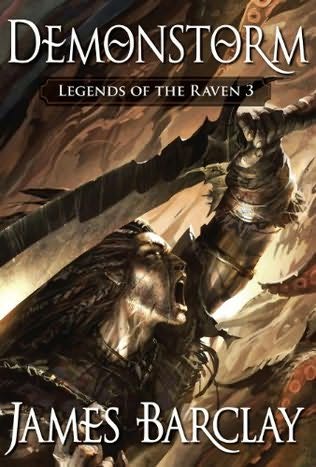
Gollancz slapped some striking covers on James Barclay's Raven novels. I must say though that the artwork for his upcoming novel doesn't really work for me - seems rather D&D-ish (don't get me wrong, I love D&D - just not on my book covers). The tagline - They live for thousands of years, now they are trying to kill each other - sounds awkward.Still, mustn't judge a book by its cover and all that. Here's the synopsis:
The elves have fled to Calius, seeking to escape the overwhelming power of the demonic Garonin. A desperate last stand in their own dimension saved the race, at the cost of 100,000 elves lost to the Garonin.
The elf who led that fight, Takaar, is blamed for the losses and has gone into hiding. Now the weakened elf race is tearing itself apart in civil war, human mercenaries have arrived in Calius and are ripping the continent apart. Only one elf can unite the elves. And only one elf believes in him.
A young warrior named Auum sets out to bring back the shamed hero and save the elven race. James Barclay's ELVES trilogy will tell the whole story of his immortal elven race, and will appeal to all fans of Tolkien and fantasy - this is a uniquely entertaining take on a fantasy staple perfect to bring new readers to Barclay. And old readers of James Barclay will welcome a return to one of their favourite creations and will also love seeing one of their favourite characters again - the Tai Gethan warriror Auum destined to be one of the Raven.
Sounds like fans of Barclay's high-octane action fantasy won't be disappointed. Elves is slated for a 21 January 2010 release.
Monday, 13 July 2009
Purple and Black - artwork and synopsis
This is an interesting upcoming release from Subterranean Press this month:Subterranean Press is proud to announce a new novella by the enigmatic author of The Company and The Engineer Trilogy.
When his father, brothers and uncles wiped each other out in a murderous civil war, Nicephorus was forced to leave the University and become emperor.
Seventy-seven emperors had met violent deaths over the past hundred years, most of them murdered by their own soldiers. Hardly surprising, then, that Nico should want to fill the major offices of state with the only people he knew he could trust, his oldest and closest friends.
But there's danger on the northern frontier, and Nico daren't send a regular general up there with an army, for fear of a military coup. He turns to his best friend Phormio, who reluctantly takes the job.
Military dispatches, written in the purple ink reserved exclusively for official business, are a miserable way for friends to keep in touch, at a time when they need each other most.
But there's space in the document-tube for another sheet of paper.
Purple and Black will be printed in two colors throughout.
I really like this idea of using two different colours for the prose, purple for the military dispatches and then black for the personal correspondence. Sub Press are well-known for the aesthetic quality of the books they produce, so expect Purple and Black to look very swish indeed - especially if the striking, yet subtle, artwork is any indication.
As for the quality of the story, I've not read any of K. J. Parker's work before but I've heard some good things.