Friday, 29 February 2008

Upcoming content for Speculative Horizons

Just a quick post to let you all know what's on the radar for Speculative Horizons.

If you read my post about the SF Site's reader's Top 10 for 2007, you'll know that I was slightly embarrassed that I'd only read two of the novels that made the cut. To rectify that, I bought Dan Simmons' The Terror and am currently about 1/4 of the way through. It's a bit of a monster, so the review won't appear for a while yet but definitely will at some point. All I can say for the time being is that I can see why this book was nominated.

I'm currently working on an interview with Mark Newton, who I mentioned in my last post. Like I said, Mark's an editor at Solaris and as such the interview will focus on genre publishing and the fantasy scene in general. I know Mark's got plenty to say on the subject, so it should definitely be worth reading. Not sure when the interview will materialise, but shouldn't be too long. Watch this space.

I'm also going to be starting a series about authors' favorite characters in genre fiction. The idea is that every week an author will reveal who their favourite character is and why. First up will be John Marco, in the near future. Once again, watch this space.

Lastly, I'm also hoping to hold the first book-giveaway at some point; more news on that as and when.

I hope you'll agree there's plenty to look forward to. I ought to take this opportunity to thank you all for visiting Speculative Horizons; I had no idea the blog would prove to be this popular so quickly, or that my audience would prove to be so global. So thanks a lot for dropping by; I hope you've enjoyed it so far.

I know I have.

Thursday, 28 February 2008

The Road To Publication

I've been chatting a fair bit this week to a nice gentleman called Mark Newton, who is the assistant editor at new-ish genre publisher Solaris.

Mark is currently writing a series of articles about how to get published, with advice on what common pitfalls to avoid and how to make your work more appealing to publishers (and agents).

The real value of these articles is the fact that Mark is an 'insider' as it were, who has valuable knowledge of the industry. This, I feel, lends some real weight to his advice (in other words, he knows what he's talking about). Mark also happens to be an author in his own right, having signed a deal that will see his fantasy novel The Nights of Villjamur published by Macmillan.

You can find Mark's articles on his blog: http://blog.markcnewton.com/

His main website can be found here: http://markcnewton.com/

Wednesday, 27 February 2008

Worlds of Fantasy

Fantasy fans in the UK take note: tonight on BBC4 at 9 pm the first episode of The Worlds of Fantasy will be shown. It's a TV series about fantasy literature, and throughout the series we'll see plenty of interviews with authors, including Joe Abercrombie.

Tonight's episode allegedly looks at the idea of the child hero, while the next focuses on worldbuilding. The whole thing is pretty exciting to be honest, as fantasy gets a pretty bad press most of the time in the media (that's if it is mentioned at all). It'll therefore be great to see the genre getting some national TV coverage.

Tuesday, 26 February 2008

Just a thought...

Saw this on the BBC news website: http://news.bbc.co.uk/1/hi/entertainment/7265301.stm

MKR allege that Capcom have infringed the copyright of Dawn of the Dead, because their game Dead Rising features a 'thoughtful social commentary on the 'mall culture' zeitgeist.'

How exactly Dead Rising manages this when all the player does is run around twatting zombies with a range of weapons from baseball bats to inflatable teddy bears is anyone's guess.

Monday, 25 February 2008

Crap fantasy book covers #5

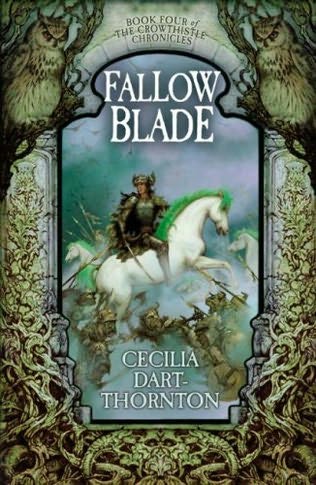
Yes, boys and girls, it's time to delve once more into the murky world of crap fantasy book covers. Today I thought I'd look at one which I actually saw in Waterstones earlier on today: Fallow Blade, by Cecilia Dart-Thornton, book four of the Crowthistle Chronicles.

Now, I actually like the artwork for the other books in this series. I like the colour tones and the borders, with all the little critters around the edges.

But the artwork for Fallow Blade is a bit rubbish. Five words: horses with bright green manes. What is otherwise a decent picture is ruined by the ludicrous colour of their manes. Look at the tones of the other colours: earthy, moody, natural. Then look at the colour of the manes: luminous, almost neon-like. In short, they stick out like a sore thumb.

I think I know where this misguided inspiration came from:

Yes, My Little Pony. Shock. Horror. But's it's true. Look at the pony on the right. It's the spitting image of the horse on the front of Fallow Blade. It's like My Little Pony versus the evil goblinoids.

Shame! Such blatant plagiarism! Shame on you, Mr Artist Sir!

Crap-o-meter rating - 6/10

Saturday, 23 February 2008

Ian Graham returns!

Let me tell you a story.

Way back in 2002, a book called Monument was published by Orbit, here in the UK. Written by first-time author, Ian Graham, it followed the story of a man called Ballas. Most protagonists in fantasy novels are good-looking, courageous and honourable. Ballas wasn't. He was a bastard. He was big, ugly and overly fond of his drink. When a priest saved him from a beating, Ballas stole from him. In short, he was one of the most repulsive anti-heroes you'll ever meet. And this is what made the novel so great. Well, that and Graham's wonderfully visceral prose and the bleak world he created. I loved Monument. I don't tend to re-read books, but Monument was an exception. When I heard that Graham was working on a new novel called Blood Echo, I waited impatiently for the novel to be released.

I waited 6 years.

In fact, until an hour ago I was still waiting. My emails to the publisher had been met with vague reassurances that the novel would surface at some point, but deigned to say when. As the years passed, I started to wonder what the hell was going on. Monument had generally been well-received, and it seemed odd that after making a strong impact a new author should just disappear off the radar. Internet searches yielded nothing. It seemed that Ian Graham had just vanished. I never lost hope that Blood Echo would appear, but got to a point where I severely doubted it.

Then, tonight, everything changed. I was thinking it was time to do another 'crap fantasy book cover' feature, so was hunting around the internet. I vaguely recalled seeing the American artwork for Monument a while ago, and thinking it was a bit naff, so I googled it to check it out. Seconds later I found myself looking at a photo I'd never seen before, yet I recognised the guy in it. It was Ian Graham. I glanced at the link. No, I thought. The link was for a site called IanSGraham.net, and there is no 'S' in the guy's name. Then I realised the images of the Monument cover that the search also brought up shared the same link.

Three words: Oh - my - God.

After all this time, a website for Ian Graham. A new website. But far better still, information about what exactly the hell had been going on. Turns out that Ian scrapped Blood Echo, as it wasn't working. Quite a brave move by him, as he must have known the delay it would cause. But credit to him, he realised the character and plot were not working and so he made a big decision that I'm sure is for the best. Then the best news ever: he's working on a prequel to Monument, featuring Ballas again.

Awesome, just awesome.

Why am I telling you this? I don't even know. It has just made me extremely excited and I had to share it with someone, so you guys drew the short straw I'm afraid. I've always championed Ian's work, and it kind of depressed me that so many readers of the genre hadn't heard of him. Hopefully now he'll receive some of the attention he deserves.

I'm going to re-read Monument and will post a review as soon as possible. In the meantime, here's the link to his new website: http://www.iansgraham.net/Home.aspx

Artwork for A Dance with Dragons

The first thing I thought of when I heard about this was Cyrus's famous quote from The Warriors film:

"CAN YOU DIG IT, SUCKERS?"

Oh, I can dig it alright. I probably wasn't the only Martin fan who squealed with delight and almost wet myself as the cover art for A Dance With Dragons was unveiled. Apart from anything else, it's probably the strongest indication that this long-awaited tome might actually surface later this year.

You can check out the (fresh and minty) artwork over at The Wertzone: http://thewertzone.blogspot.com/2008/02/coming-soon-dance-with-dragons-and-some.html

Thanks to Adam for the scoop. Now we just all cross our fingers and hope.

Friday, 22 February 2008

Book review: The Red Wolf Conspiracy

The Red Wolf Conspiracy

By Robert V. S. Redick

(Gollancz 2008)

Gollancz have an impressive track record over the last couple of years; first they snapped up Scott Lynch and watched the hype reach a crescendo, then they repeated the trick with Joe Abercrombie and enjoyed similar results. Both Abercrombie and Lynch delivered debuts that generally garnered much critical acclaim. When Gollancz announced they had tied up a deal with first-time American fantasy author Robert V. S. Redick, the question was on everyone's lips: could they do it again?

Although it was only released in January 2008 in the UK, Redick's The Red Wolf Conspiracy has already caused a bit of a stir, including - whisper it softly - more than one prediction that it could be the debut novel of the year, and that Redick could be -whisper it even more softly - the Next Big Thing. Big words, but hype is a double-edged sword. While it helps sales, it can make it harder for the book to meet expectations. So, the key question: does Red Wolf deliver? Read on to find out...

Straight away it is clear that this is not your typical fantasy novel. As the story progresses however, it becomes obvious that there are more familiar fantasy elements involved than were first made apparent, however the setting is not so standard. Red Wolf follows the voyage of the great ship Chathrand, a 600-year-old behemoth of a vessel that is the last of its kind. The ship is on a mission of peace, to strike a truce between two mighty empires. At least that is what everyone is meant to believe. The truth is far different, and may instead plunge the world into war.

From what I'd read in advance, I was expecting something resembling a political thriller at sea. I'm fond of a bit of backstabbing and political machinations, so had high hopes that Red Wolf could deliver an intriguing storyline full of twists and turns. Sadly, it doesn't quite deliver. The actual conspiracy, when unveiled, is completely plausible (and actually quite clever) but the much-hoped-for political blood-letting and treachery never really materialises. Instead, the plot then goes on to follow a relatively standard course treading more familiar fantasy ground (magic artifacts, evil sorcerers, etc). It's not a bad plot by any means, but not what I expected, or hoped for. There are a few surprises, but too few in my opinion.

The nautical nature of the novel gives Redick a broad canvas to create some really memorable characters. Much like the plot, the characters on first glance sound interesting. And much like the plot, they don't quite deliver. The characterisation was one of the main disappointments for me, and I'll tell you why: because there are so nearly some fascinating characters here, but most are not fully realised. For example, Nilus Rose, Chathrand's captain, is clearly bordering on insanity, but I don't feel Redick quite gets under his skin enough. Similarly, Sandor Ott, Chief Spymaster of the Imperium, could have been a really interesting customer, but once again we don't see enough depth to quite flesh out the assumptions we form about him. The main protagonist, Pazel, is easy to sympathise with and root for, but his co-protagonist Thasha comes across as a minorly irritating, forthright tomboy.

Other reviewers have been quick to point out the vivid, well-realised world that Redick has created, and I won't dispute that there are many interesting aspects to his world. Yet for some reason I wasn't as drawn into it as I could - or maybe should - have been. I think the main cause was the fact I noticed several quirks (I hesitate to call them inconsistencies) that were a little bewildering. For example, the ships use cannons (and have done so for centuries, it seems) so gunpowder is common currency. Gun technology should therefore be well developed, yet pistols are non-existent and crossbows are used instead. I never got the impression that Redick's world was medieval, yet neither could I pin it down as early-modern. It seems to borrow a bit from both time periods. Subsequently, I never managed to envisage the world as effectively as I might have done.

There are many aspects of the novel that I liked. The idea of the Chathrand - a 600 year-old-ship - was really interesting, and it was refreshing to read a novel that mixed familiar notions with a less conventional setting. Redick certainly isn't afraid to introduce some fresh ideas, such as the Ixchel (which admittedly I wasn't keen on) and the 'woken' animals (which I thought was a nice touch - the rats especially are really well worked). Redick's prose flows well, though Pazel and Thasha do come across as younger than they are meant to be.

The plot structure is sound and builds to a satisfying finale, although the end, with everything set up nicely for book two, does cause the book to end on a bit of a flat note. Still, The Red Wolf Conspiracy is a decent, enjoyable debut, even if it doesn't live up to its potential. Redick however has shown a glimpse of real ability, and if he can add more depth to his characters and a little more surprise to his plots, he could go on to do good things in the genre. This debut is not as explosive as those of Lynch or Abercrombie, but you can't help but think that Gollancz might have pulled off another coup. Only time will tell.

7.25/10



Thursday, 21 February 2008

SF Site's top 10 of 2007

Having seen the top reads of 2007 as stated by the SF Site, I feel slightly embarrassed to admit that I've only read two of them - Joe Abercrombie's Before They Are Hanged, which pops up at number 5, and Scott Lynch's Red Seas Under Red Skies. Interestingly, Red Seas Under Red Skies only manages 9th on the list - he was 1st the year before. Either there were a lot of quality books released last year, or fans didn't quite enjoy his second novel as much as the first.

Harry Potter makes the obligatory appearance, along with heavyweights such as Dan Simmons and Steven Erikson. I've heard good things about Simmons' The Terror, and have been meaning to pick it up for a while.

No surprises who is at number 1 - Patrick Rothfuss, with The Name of the Wind. I've got a first edition copy of this novel on my shelf where it has been gathering dust for months. I will get around to it at some point. The hype has matched that which surrounded The Lies of Locke Lamora, so I'm slightly worried it won't meet my expectations. It certainly sounds damned good though.

Here's the link for the full list: http://www.sfsite.com/columns/best08b.htm

Blurb for Abercrombie's Best Served Cold

I know this is a bit belated, as this blurb actually surfaced a couple of weeks ago, but in case you've missed it here's the synopsis for Joe Abercrombie's upcoming novel Best Served Cold, ripped straight from Amazon.co.uk:

Mercenaries are a wonderful thing: they fight as you tell them, whom you tell them, and when you tell them, for nothing more precious or complicated than money. And Monzcarro Mercatto, and her brother (and lover) Benna Mercatto, are the two most successful, most popular, and most wealthy mercenaries in Styria...but wealthy, popular mercenaries are not such a good thing. In fact they're a downright dangerous thing. Which is why Grand Duke Orso of Styria arranges to have them dealt with. Permanently. With hindsight, he may come to consider this a tactical error. Through sheer good luck - which her brother doesn't share - Monzcarro survives the long and fatal drop Orso arranged for her, and staggers away from her encounter with a ruined right hand, an opium addiction ...and a plan to come back with a fortune, plently of bladed weapons, and a single-minded determination to kill the seven men in the room when her brother was murdered. Preferably in as gruesome a manner as she can ...

I like the sound of this; it sounds like a gritty urban adventure with plenty of blood. It's nice to see an author writing a stand-alone novel, especially after enjoying success like Abercrombie has had with a trilogy. Furthermore the story appears to be set largely in Styria, which is unexplored territory, and features a mostly new set of characters. I'm glad though that Duke Orso is involved; without giving anything away, we catch a glimpse of him in Last Argument of Kings and I immediately got the impression that he is a slippery character.

Joe's mentioned that the going has been tougher than he thought, but he reckons he's still on course to deliver the manuscript to Gollancz in a few months. Release date - according to Amazon - is April 2009.

Damn, now that I think of it that's quite far away. Still, if it does come out then it will keep up Joe's record of having a book published every year since his debut novel was released. In these days when several years seems a standard amount of time to have to wait between novels, that's certainly a good thing.

Tuesday, 19 February 2008

Recommended reading: David Gemmell

I thought it would be fun to do a series of short articles about some of the authors I've enjoyed reading in the past, giving a brief introduction to their work and suggesting a starting point for those that are unfamiliar with their work.

The first author I've chosen to write about is one of my all-time favourites: legendary English fantasy author, David Gemmell. I don't use the term legendary lightly. Gemmell, who sadly died in 2006 from coronary artery disease, was a hugely influential figure (both in person and through his writing) and wrote 32 novels in his lifetime.
I don't want to go on at length about Gemmell himself; there are numerous obituaries that do a far finer job than I could. It will suffice to say that he was a thoroughly decent man, whose strong moral beliefs and ideas about the nature of humanity infused his work. The fact that thousands of fans signed the online condolence book set up after his death illustrates to some degree both his popularity and the influence he had on so many people, both readers and writers alike.

Gemmell's writing is what I want to focus on here. Although his Troy trilogy (of which the third book he was still writing shortly before his death) has had rave reviews, he will always be best known for his Drenai novels. Heralded as the 'finest living writer of heroic fantasy' during his lifetime, it's easy to see why. Largely eschewing world-building in favour of strong characterisation, Gemmell created a slew of memorable characters, such as Druss the Legend, the assassin Waylander, Skilgannon the Damned and Tarantio the swordsman with two souls.
What made Gemmell's characters stand out was their sheer humanity. All were flawed to some extent, whether it was their inability (or refusal) to accept the inevitable (such as Druss and his battle against old age and impossible odds) or the demons of their past (Waylander and Skilgannon). The struggles of these characters, and their ultimate redemption is what makes them so endearing.
As mentioned above, Gemmell's beliefs about humanity and his moral code permeated his works, reflected in the actions of his heroes. All of them - flawed as they are - are similar in that they always try to do the right thing, no matter how hard. Gemmell believed that redemption was always possible, that victory was always achievable despite the odds. Subsequently his characters always strove for the greater good, even it involved personal sacrifice. Gemmell's creations are not just characters, they are heroes, examples of the potential of human nature and illustrating what can be achieved when one tries their utmost. Yet he was adept at showing the darker side of humanity. I always remember the way Gemmell introduced the Jiamads (werewolf-like creatures) as mindless beasts, yet skilfully changed the way they were portrayed so that in the end it was mankind that was revealed as the true animal.

Gemmell was known not just for his masterly characterisation, but also for his battle scenes. Few authors can match the power and urgency of his combat sequences. His prose is sharp and concise, without flowery ornamentation. Gemmell once remarked that he was more interested in making things happen than describing the surroundings, and this is reflected in his work time and time again. His plotting is tight and without any baggage; to this day, his debut novel Legend is a great example of a perfectly plotted book, with scarcely a single unnecessary line.

No one writes quite like David Gemmell did. His sense of pace, battle scenes, emotionally-scarred characters, the various themes of love, redemption and heroism...all of these combine to make his books unique. Few authors can portray human nature as well as Gemmell did.
It is to my eternal disappointment that I never had the chance to meet David Gemmell, but there's no doubt his legacy lives on in his writing.

Recommended first purchase: Legend

Gemmell's debut novel, written while he was being tested for cancer. While some of the prose is clunky, the story is timeless: a huge, impenetrable fortress faced with the biggest army ever assembled. A classic siege story, with wonderful characters and deep themes. Druss the Legend's first appearance. Probably Gemmell's most famous work and arguably his best (it certainly gets my vote).

Recommended follow-up purchase: Waylander

Another of Gemmell's most popular novels, not to mention one of his best characters. Notable for causing Gemmell to lose his journalism job, after his managing director dismissed the novel as a 'poisonous attack on his integrity.' The novel follows Waylander on his attempt to find the Armour of Bronze, in a bid to save the kingdom whose king he had previously murdered. A fantastic example of Gemmell's powerful characterisation, with riveting action sequences. And Waylander's dual crossbow is possibly the coolest ranged weapon ever.

Recommended 'wildcard' purchase: Lord of the Silver Bow

If you don't fancy starting with Gemmell's Drenai novels, this is probably the best other place to start. I've not read the novel (I'm saving it), but Gemmell's Troy trilogy is regarded by many as his best work. Lord of the Silver Bow is the first in the trilogy, and by all accounts contains everything that makes Gemmell's work so appealing.

For further info, check out these links:

Wikipedia entry (includes extensive, interesting biographical info): http://en.wikipedia.org/wiki/David_Gemmell


Guide to Drenai saga: http://www.drenai.com/


Sunday, 17 February 2008

Crap fantasy book covers #4

I don't normally agree with anything Terry Goodkind says. It's difficult to agree with someone who said that gang-rape is "democracy in action." I'm not sure Plato would agree, Terry. I certainly don't. I could go on at great length about how much I disagree with the holier-than-thou words of Goodkind, but perhaps I'll save that for another day. Or until his next interview, which no doubt will throw up a few new gems.
But, back to the point. Goodkind said something the other day that I actually agreed with: that some of his book covers were shit. Now, he probably thinks this because they are too 'fantasy' for him (Goodkind doesn't write fantasy, you see. He writes literature. Apparently). Well, whatever his reasons I can at least see where he is coming from. Check out this one, from his third novel Blood of the Fold:


Not great is it? A dragon clinging to a pillar. A bloke - Richard Rahl, one presumes - wearing some hideous yellow shirt his uncle gave him for Christmas. Some stripper in red bondage gear complete with eighties femme de mullee (that's female mullet, to you and me). And that's about it. Hardly inspiring. Still, at least Goodkind's publisher recognised his work as fantasy, which is more than we can say of Mr Goodkind himself.

Crap-o-meter rating: 8/10

Saturday, 16 February 2008

Indiana Jones and the Kingdom of the Crystal Skull trailer

As a big fan of Indy, I wasn't sure how to feel when I heard the news that a fourth movie was finally coming together. Excitement definitely, but wariness at the same time. I hate it when studios rustle up a half-baked sequel to a popular film, just to make a few bucks. Especially when they wait 10 years to do it. My main fear was that the new Indy film would fail to re-create the atmosphere of the original trilogy.
Having watched the new trailer, I've lost a lot of my concern. To be blunt, the trailer is really promising. The stunts, big explosions, off-the-cuff humour and dusty tombs are all present and correct, and Ford still looks the part. As the old music soars over the action, you'd be forgiven for giggling deliriously. Roll on May.

Thursday, 14 February 2008

Book review: The Blood King

The Blood King

By Gail Z. Martin

(Solaris 2008)


Gail Z. Martin's debut novel The Summoner was a bit of a surprise; a novel that embraced some of the most common fantasy elements and forged them into a highly readable novel. I was therefore interested to see if Martin could meet my heightened expectations in the second book, The Blood King.

The scene was certainly set plot-wise, with Tris and his allies planning their invasion of Margolan to cast down the evil usurper, Jared Drayke. At the same time, Tris struggles with both the power that flows through him and the doubt that plagues his mind. All the ingredients were in the pot; it was time to see what happened when they were all mixed together and left to simmer.

While The Summoner was a good debut novel, it did (inevitably) contain one or two rough edges. These are mostly ironed out in The Blood King; thankfully the word 'rasped' is used much less frequently for a start. There are still moments where the odd snatch of dialogue breaks the atmosphere, such as Jared's irritating insistence that he could always "whip your [Tris's] ass" which jars a little (I always have difficulty imagining an inhabitant of a medieval-esque world saying the word 'ass' in that context). Still, Martin's prose and dialogue has always been a strong point and continues to be so in The Blood King.

As the story develops, it takes on a darker edge than we saw in the first book. I particularly liked the introduction of the ashtenerath and the appearances of the Formless One. The religious aspect of Martin's series - the eight aspects of the Goddess - is something that works well for me, and I enjoyed seeing this particular aspect in more depth. One problem that affects some novels (and Martin's to a certain extent) is that when a divine entity champions a mortal individual, it blurs the line between free-will and destiny, sometimes making the plot concerning that character a bit redundant in the sense that you always expect them to succeed, given their divine assistance. This is not really the case with The Blood King, yet it did cross my mind now and then.

Martin continues to develop the relationships between her characters, which are at all times believable if a little predictable. It was good to see Gabriel and Mikhail involved more in the proceedings, as vampires are always pretty cool. I would have liked a bit more involvement with the Blood Council, as I think there could have been some interesting plotlines if they were involved more fully.

I get the feeling however that the next book in the series (which will begin a new story arc) will include the council a lot more. There's life yet in these creatures of the night.

So, Martin's writing is as strong as it was the first time around, there are some interesting darker elements added to the mix and the characters are still engaging. Sounds like we're onto another winner here, right? Sadly, not quite. There is only one real flaw with The Blood King, but it's a big one: the plot doesn't measure up.

Going back to the idea of using well-trodden fantasy tropes, my line of thinking is that there's no problem with writing, for example, a story with a dark lord, a magic sword and a farmboy hero...as long as you mix it up a little. Not just for the sake of it, but to make the story more individual, to add a bit of panache to the proceedings. An element of surprise.

This is where The Blood King falls short; everything is set up nicely for the concluding part of the story, but unfortunately it's all too straightforward. There are precious few twists and turns, and you can't escape the feeling that you know exactly how it's all going to pan out. There were one or two moments where I actually felt my interest waning slightly. Added to this are a couple of holes in the plot including one which has such a crucial impact you can't believe the character in question was dumb enough to let it happen. It's just all a bit too tidy, too convenient. Furthermore, the ending is a bit of an anti-climax, it just seems too low-key. I was expecting fireworks, but only got a couple of firecrackers instead.

This drawback isn't enough to ruin the book, which is still an enjoyable read, but it does let down the intriguing world and engaging characters that Martin has created. Still, with Martin contracted to write two more novels in the series, there's a chance for redemption. Martin has shown she can write and create absorbing worlds and characters, all she needs to fully deliver is provide a more exciting, less predictable plot and we're on to a winner.

7.25/10

Wednesday, 13 February 2008

Major US deal for Redick

Robert V. S. Redick's debut novel The Red Wolf Conspiracy has only been out for a few weeks but is already making a big noise in the UK speculative scene, and has been earmarked by several other bloggers as an early contender for debut of the year.

Now, American readers can look forward to seeing what all the fuss is about. John Jarrold, Redick's agent, has just announced a three-book deal with Del Rey for a six-figure sum (in US dollars).

Looks like Redick is already hot property. Soon I'll find out if the hype is justified, as I begin Red Wolf tomorrow. I'll hopefully have a review up in the near future.

In the meantime, keep your eyes peeled for a review of Gail Z. Martin's The Blood King, which I finished yesterday.

New Line Cinema sued by Tolkien estate

New Line Cinema just seems to lurch from one PR disaster to another. First they were involved in a lengthy legal battle with Peter Jackson over unpaid royalties for the Lord of the Rings films, now they are involved in a similar dispute with the estate of Tolkien over $150 million. Apparently, Tolkien's estate received a desultory payment of $62,500 and have received nothing since in terms of royalties.

The worst part is the revelation that "legal action could delay an expected prequel to the fantasy epics."

I remember seeing an interview with one of the fat cats at New Line and I thought at the time he was a slimy bastard, so the news the company is involved in more legal wrangling over profits doesn't come as much of a surprise. It's just another indication that Hollywood is about money rather than art.

You can find the full article here: http://news.bbc.co.uk/1/hi/entertainment/7240421.stm

Tuesday, 12 February 2008

Film review: Tales From Earthsea


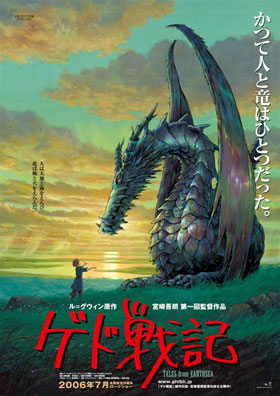
After the disappointing TV series based on Ursula Le Guin's A Wizard of Earthsea, I was interested to see if Studio Ghibli could do any better. Studio Ghibli has forged an impressive reputation thanks to the superb quality of their animation and direction - the latter largely due to mastermind Hayao Miyazaki - as well as the thoughtful, emotional nature of their films. Having created masterpieces such as Spirited Away and the epic adventure Howl's Moving Castle, Studio Ghibli seemed well placed to deliver another stirring adventure in Tales From Earthsea. I certainly had high hopes; while not a massive fan of anime, I have nonetheless enjoyed the Ghibli productions I have seen so far and can appreciate the superb animation and production of their releases.

So it was a bit of a surprise to find that Tales From Earthsea falls well short of the standard I think we've all come to expect from Studio Ghibli.
The main problem with Tales From Earthsea is the storyline. I've only ever read the first book in the Earthsea series and that was a long time ago, but nonetheless I can remember fragments. Subsequently I hoped Tales From Earthsea would follow the storyline of the first book, where Ged the farmboy becomes a wizard. Instead the film follows what is allegedly a plot cobbled together from the third and fourth books in the Earthsea series. The result is an uninspiring tale about Ged (fully-grown) and Arren (a young prince who murdered his father) teaming up to defeat the evil wizard, Lord Cob. The disappointingly predictable plot plods along and only really gets going towards the end of the film, by which point I was past caring. Ghibli is known for its warm, distinctive characters but those in Earthsea feel strangely lifeless; there is no real spark. Arren's inner torment is not really illustrated enough, nor for that matter is Therru's. The only character that makes any real impression is the uncomfortably androgynous Lord Cob, excellently voiced by Yuko Tanaka.

Even the animation is a pale imitation of Ghibli's usual excellence; there are some nice backgrounds and the dragons are superbly done, but the usual atmosphere that Ghibli visuals evoke never really materialises. Earthsea is portrayed well enough, but doesn't sparkle as it should. Alongside the visual mastery of fantasy adventure Howl's moving Castle, Earthsea pales hopelessly in comparison.
Perhaps the failings of Earthsea are down to the fact that the film was directed by Goro Miyazaki, son of the renowned Hayao, and that it is his first film. Whatever the reason, there's no hiding the fact that Tales From Earthsea is a big disappointment. The fact that Le Guin herself commented "This is not my book"after watching the film indicates that she wasn't impressed either.
With the failures of the earlier TV series and now Ghibli's Tales from Eathsea, fans will have to wait longer for an adaption that does the series justice.
5/10

Monday, 11 February 2008

Blurb for Lynch's Republic of Thieves

Scouring the internet for news on Scott Lynch's forthcoming Republic of Thieves, I found on westeros what is allegedly the blurb for the next novel in the Gentleman Bastards sequence. WARNING - this blurb does contain minor spoilers if you've not yet finished Red Seas Under Red Skies. In fact, it also gives away perhaps too much of what happens in Republic of Thieves...

The supposed blurb reads as follows:

"Having pulled off the greatest heist of their career, Locke and his trusted partner in thievery, Jean, have escaped with a tidy fortune. But, poisoned by an enemy from his past, Locke is slowly dying. And no physiker or alchemist can help him. Yet just as the end is near, a mysterious Bondsmagi offers Locke an opportunity that will either save him-or finish him off once and for all. Magi political elections are imminent, and the factions are in need of a pawn. If Locke agrees to play the role, sorcery will be used to purge the venom from his body-though the process will be so excruciating he may well wish for death.

Locke is opposed, but two factors cause his will to crumble: Jean's imploring-and the Bondsmagi's mention of a woman from Locke's past: Sabetha. The love of his life. His equal in skill and wit. Locke was smitten with Sabetha from his first glimpse of her as a young fellow-orphan and thief-in-training. But after a tumultuous courtship, Sabetha broke away. Now they will reunite in yet another clash of wills. For the opposition knows of Locke's recruitment and has cleverly secured Sabetha as their countermeasure. Faced with his one and only match in both love and trickery, Locke must choose whether to fight Sabetha-or to woo her. It is a decision on which his life may depend. "

First up, I think this blurb is pretty crap; it gives away far too much of the plot. That said, I like what I hear. Although it does sound a little similar to the plot of Red Seas (ie two factions both trying to use Locke and threatening to bump him off if he doesn't comply) I do like the idea of Locke going up against Sabetha, and having to choose with his head or his heart. I'm very much looking forward to meeting Sabetha for the first time. Furthermore, it'll be great to have Bondsmages involved in the action once more. I felt their absence quite keenly in Red Seas, and The Falconer from Lies was a terrific villain.

There's been a bit of debate as to how long the book will be: Amazon.com says 800, Amazon.co.uk says 512. I think 800 is too high; Red Seas was over-long and I don't want the same problem to befall Republic. We'll just have to see. Expect the novel to surface in June (UK) and August (US) this year.

Sunday, 10 February 2008

Fantasy promo videos

The rise of YouTube, where any halfwit with a video camera can become an instant celebrity (yes Chris Crocker, you dipshit, I'm looking at you) has meant two things for companies: cheap publicity and a potentially huge audience. It's perhaps inevitable that publishers would latch onto the idea of producing promotional videos that (equally inevitably) end up on YouTube. That's not to say the videos are all good or worthwhile...but all publicity is good publicity as they say. Here's a selection of some fantasy promo videos.

First up, a video for The Chronicles of the Necromancer series by Gail Z. Martin that I'm having plenty of fun with right now. It's pretty short and nothing spectacular, but at least spreads the word around. http://uk.youtube.com/watch?v=1BaaGqiXqiE

Next up, a promo video from a couple of years back. Scott Lynch discusses debut novel The Lies of Locke Lamora. This is the sort of video publishers should shoot for; it has plenty of info without being overbearing, enables the potential reader to connect with the author and isn't overlong. http://uk.youtube.com/watch?v=uDlvTFh9IiQ

Another Scott Lynch promo video/interview, this one more recent. http://uk.youtube.com/watch?v=yG3fNJxG8wg

This last one is promoting Karen Miller's fantasy duology Kingmaker, Kingbreaker. Personally I think this is a weak promo video; it in no way makes me want to rush out and buy the book. Miller makes her novel sound about as interesting as watching paint drying. Actually, no: about as interesting as watching paint. http://uk.youtube.com/watch?v=FbNoHoveDiQ

Friday, 8 February 2008

Valleys of the Past #2 - Fighting Fantasy

Tonight the Euro Millions lottery prize stands at 95 million - the largest total in the history of the lottery. And I can't buy a freakin' ticket because every god-damned man and his dog have all had the same idea, and the website has crashed. Great. So, to banish the thoughts of what I would have done with 95 million, I thought I'd write a bit more about how I got into fantasy (a poor substitute, I concede, but probably more relevant to this blog).

I mentioned before how Tim and the Hidden People had sparked an interest in all things mystical and magical. After I devoured all the Hidden People books I could find, I returned to reading 'normal' kids' books. But the fantasy spark was always there, even if it lay dormant.
The defining moment came when I was about 11 years old. At school we had this scheme called the Puffin Book Club. You got handed a little pamphlet with pictures and descriptions of books. You chose what you wanted, returned a slip with the money and then later the books would be delivered to school.
On one issue of the pamphlet, they had a book called Return to Firetop Mountain. Here is the original cover in all its glory.


To this day I have no idea why I wanted that book, but I did. When it arrived, I found out it was the 50th book in a series called Fighting Fantasy. These books were like other adventure books on the market, in that you were given a choice of action (fight, flee, use a magic item, etc) and then skipped to the appropriate paragraph to continue the story. It enabled you to actually dictate the story and chose how it worked out, and that to me was pretty cool. It still is.

The main difference with Fighting Fantasy was that most of the books were set in a fantasy world, full of the usual elves, dwarves, dragons and wizards. This probably sounds totally generic, but for an 11-year-old who had never experienced this sort of thing before, it was almost a spiritual experience. I got hopelessly sucked in and picked up more of the books. While the combat system was basic, to just be part of these adventures and play an active role was hugely rewarding.
I spent many, many happy hours exploring Allansia, the Old World and Khul. I trekked through the desolate Moonstone Hills, braved the shadowy streets of Port Blacksand and traversed the dangerous paths of Darkwood Forest, to name but a few locations. I fought monsters, haggled with merchants, dabbled with magic and saved the world several dozen times over (naturally). Fighting Fantasy books were an escape for me for many years. Naturally, the series eventually grew to a halt as its popularity waned due to the growth of video games and petty vandalism. Around the same time, I 'graduated' onto grown-up fantasy and the die was cast.
My love for the Fighting Fantasy series never left me though. Later, in my university days my interest was rekindled and I decided that I had unfinished business with the series. Despite my love for them, I never actually collected all the Fighting Fantasy books. Not even close. I decided that this was a wrong that I needed to put right, and could do so thanks to the wonder that is ebay. Over the next two years, I managed to collect all 59 books. It wasn't easy. As the series had wound down, fewer copies had been published. This made the later books far more difficult to get hold off, as there were less of them. To complete my collection, I had to import books from Australia and the States as some were simply not available in the UK. Some of the rarer books (55 onwards) were rather expensive too, regularly going for £40 ($80) a book. Still, I got there in the end and am now the proud (and super-geeky) owner of the entire collection, plus all 4 books of the Sorcery! sub-series, the Out of the Pit bestiary and Titan, the world-guide. I also have two of the novels, but somehow never got the third. That will have to be rectified.

I would take a picture of my collection, but sadly my camera goes through batteries quicker than a beggar in a bakery, and so such a picture will have to wait.
There was fresh excitement on the Fighting Fantasy front a few years ago when Wizard books picked up the rights and re-printed the early gamebooks with brand new covers. After a shaky start (and some slightly iffy covers) they managed to successfully re-market the series. Here's the front cover to Talisman of Death:


What was even more exciting was that Wizard published a brand-new adventure called Eye of the Dragon by Ian Livingstone, one of the co-founders of the series. On top of that, they published Bloodbones - the semi-legendary 60th gamebook that was shelved many years before and existed only in rumour-form for a decade on internet fansites. Come to think of it, I've not got a copy of it. Hmm. That will have to be rectified as well.
So, there you have it. I owe my love of fantasy to Fighting Fantasy gamebooks. In a parallel universe, I never ordered Return to Firetop Mountain from that Puffin Book Club leaflet, and instead today read high-brow 'literary' gobshite. Maybe.
For more info on Fighting Fantasy, check out these sites. May your dice roll high!
http://www.fightingfantasycollector.co.uk/ (fan site with all original covers)