Tuesday, 1 December 2009

A more interesting type of 'figure' cover

Evidence that you can have a figure on the cover of a book without it being dull and derivative:


I really like this cover, I think it's striking and beautifully done. I also like the fact that the focus is not just on the figure, but on the lions as well. Excellent stuff. Having checked out the blurb for this particular series, I think I might have to give it a go - sounds interesting.

Monday, 30 November 2009

Robert Holdstock - RIP

I was terribly saddened to hear of the death of Robert Holdstock, author of the much-lauded Mythago Wood novels. Holdstock was rushed to hospital with an E.coli infection on 18 November, and after remaining stable for some time, he sadly passed away on Sunday morning. He was only 61.

I've never read any of Holdstock's novels (though I've heard very, very good things), and sadly did not get a chance to say hello at the Gollancz party last month. Judging from the highly emotional reaction from the online genre scene, he will be very badly missed indeed. My thoughts are with his family.

Here are links to some posts from around the blogosphere:

The Wertzone.

NextRead.

John Jarrold.

Neil Gaiman.

Locus.

Orbit.

British Fantasy Society.

Friday, 27 November 2009

Book review: Knights of Dark Renown

Knights of Dark Renown

By David Gemmell

(Orbit, 1989)

While perhaps being most famous for his Drenai series of novels, David Gemmell also wrote a number of standalone fantasy books - Morningstar, Echoes of the Great Song, Dark Moon and Knights of Dark Renown. The main difference between these standalone books and the Drenai saga (aside from the fact that they employ different settings) is the much more pronounced use of magic in these individual titles, as well as more significant use of genre elements such as the undead, and so on.

They are also, in my opinion, distinguished from the Drenai novels by the fact that they're not as good (by that I don't mean they're bad, because they're not - they just don't match the sustained excellence of the Drenai novels). I therefore picked up Knights of Dark Renown expecting the same sort of experience.

To my considerable delight, the novel proved me wrong - Knights of Dark Renown may not be up there with Gemmell's best work, but it certainly matches most of the Drenai novels in terms of quality.

As is always the case with Gemmell novels, the premise is pleasingly simple. The Knights of Gabala were the shining light of justice and order in the Nine Duchies, until they disappeared through a portal to another world on a mission to defeat the ultimate source of evil. They never returned. In their absence, a new, sinister order of knights have emerged and have gained total influence with the king. As a result, the world is sliding into chaos - people of nomad descent are being slaughtered in their thousands in a bid to 'cleanse' the lands of their 'impurity', while law and order are non-existent.

Mannanan is the Coward Knight. A Knight of Gabala, he held back when his brothers rode through the dark portal, consumed by his own fear. Now he lives in shame, forever tormented by his failure. Yet as madness consumes the kingdom, Mannanan must confront his fears and finally ride through the portal in a desperate attempt to find the lost Knights of Gabala, who are the doomed kingdom's only hope. Meanwhile, in the Forest of the Ocean, a reluctant outlaw - Llaw Gyffes - finds himself the focus of a rebellion that he has no wish to be part of. But as the stakes increase, Llaw realises he must help spark the fires of freedom, even though it will mean his own death...

Mannanan is a classic Gemmell protagonist - he's a broken man hounded by his past failures, yet he refuses to accept his fate and is determined to do whatever it takes to make things right, even though that means confronting his greatest fear. The supporting cast are equally strong, with satisfying development arcs (particularly with regards to Groundsel, Lhamfada and Nuada). As always, Gemmell handles the relationships and emotional reactions between the characters extremely well, revealing how their own hopes and desires affect their choices and decisions, leading to some powerful scenes.

Gemmell books are known for their exploration of themes, and Knights of Dark Renown is no different. The predominant theme is heroism, with Gemmell asking the question of what constitutes a hero. Are they defined by who they are, what they do, or both? Is it possible for a murderer and a rapist to become a hero, or are they forever tarnished by their past deeds? The theme of sacrifice is also prevalent, particularly in relation to the characters of Nuada and Groundsel, whose respective storylines make for some poignant moments.

Though Knights of Dark Renown is one of Gemmell's earlier novels, the prose shows a distinct improvement over preceding novels such as Legend and Waylander, particularly in terms of the dialogue, which is more natural. Pacing is excellent with not a dull moment or a wasted scene, the plot is very well constructed, and the action scenes are - as always - vivid and gripping. There's even a good twist that no doubt plenty of readers saw coming, but I didn't (and I'm glad I didn't, because it was one of those moments when you momentarily put the book down and think "Yep, you totally got me there.").

My only real complaint with the novel is that I felt the conclusion (the last fifty or so pages) was a little rushed, not justifying the careful, gradual build-up. This also meant that the fate of some characters didn't perhaps carry the weight they could have done. There are also two duels that prove totally pivotal to the plot, yet they're over very quickly - these probably should have been beefed up a bit to justify the importance placed on them (or because of the importance placed on them).

Verdict: Knights of Dark Renown is the best of Gemmell's standalone novels, a potent mix of magic, battles and individual journeys of discovery against a backdrop of madness and disorder. With Gemmell's masterly grasp of characterisation, pleasing exploration of themes and plenty of action, Knights of Dark Renown is a hugely enjoyable, meaningful read - and yet another reminder (as if we needed one) of the gap that Gemmell's death left in the genre.
Monday, 23 November 2009

Cover art and blurb for 'The Sword of Albion'

As I think I've mentioned before, I enjoyed Mark Chadbourn's alternative-Elizabethan short story, Who Slays The Gyant, Wounds the Beast, that appeared in the Solaris Book of Fantasy back in 2007. I was intrigued by the setting and hoped that Chadbourn would follow the story with a full-blown novel, which thankfully he has. The novel is called The Sword of Albion, and here's the artwork:


Before the clamour starts, yes it's another 'hooded figure' cover, but to my mind this is entirely justified - the book is about a spy and subterfuge in general, so at least it's got a reason to use the over-familiar feature. Of course, it helps that it's a very nice cover indeed. While I like the little duel detail at the bottom, the two combatants do look rather static, as if they're both standing still - who stands still during a swordfight? But otherwise, very good indeed.

As for the blurb, it sounds very promising (please note this is only a blurb-in-progress, the final version may differ):

1588: The London of Elizabeth I is rocked by news of a daring raid on the Tower. The truth is known only to a select few: that, for twenty years, a legendary doomsday device, its power fabled for millennia, has been kept secret and, until now, safe in the Tower. But it has been stolen and Walsingham's spies believe it has been taken by the Enemy. This Enemy is not who we usually think of as our traditional opponent. No, this Enemy has waged a brutal war against mankind since time began, and with such a weapon they might take terrible toll upon England's green and pleasant land...And so it falls to Will Swyfte - swordsman, adventurer, scholar, rake, and the greatest of Walsingham's new breed of spy - to follow a trail of murder and devilry that leads deep into the dark, venomous world of the Faerie. As Philip of Spain prepares a naval assault on England, Will is caught up in a race against time in pursuit of this fiendish device...

Sounds exciting, looking forward to this one - release date is 1 April 2010, publisher is Bantam Press.

Interestingly, the novel has a different name and artwork in the States. Over there, it's called The Silver Skull, and the artwork is below:

So, the inevitable question - which cover do you prefer? Personally, I like both but think the UK version edges it.

Release date for The Silver Skull is 23 November 2009, which obviously is far earlier than the UK release date - I would urge UK readers not to import the US version, and instead wait for the UK edition to be released. Why? Because otherwise we run the risk of harming the UK version's sales and threatening the likelihood of future instalments being published over here. Chadbourn has advised that future instalments will be released simultaneously, so this problem hopefully won't arise again.

Saturday, 21 November 2009

European adventures: Krakow

Had a cool time in Krakow last week. While I feel the former Polish capital lacks the grandeur of Prague and the landmarks of Budapest, it certainly has its own charm - the Poles are a friendly, welcoming people (and they speak damned good English too, which always helps!), which makes for a warm, relaxed atmosphere. Another positive point is the fact that Poland is so cheap - a two-course meal for two with drinks in a good restaurant will only set you back about £20 ($33) - so it's a great place to go on a budget.

While we were there, we visited the salt mines at Wieliczka (disappointing) and the most infamous Nazi concentration camp of them all, Auschwitz (harrowing). More on them later. First, some photos of Krakow itself. As usual, apologies if the formatting is a bit uneven...


View of Krakow's old medieval square (still the main hub of the city) from our hotel window. We stayed at the excellent Hotel Wentzel, which I highly recommend.


The Church of St Mary (14th/15th century)


Church of St Adalbert, the smallest church in the city. St Adalbert is said to have preached here before marching off to convert the Prussians in 997.

The Market Hall Tower, the only remaining part of the old town hall.


St Florian's Gate (late 13th century) - one of the few remaining parts of the medieval city walls


Church of St Andrew (11th century)


The statures of the Apostles, outside Church of St Peter and St Paul


A Krakow street


The Royal Castle on Wawel Hill


As I mentioned, we spent one afternoon several hundred feet under ground, in the salt mines at Wieliczka, which are no longer functional and have instead been turned into a museum. To be honest, I found the whole experience rather underwhelming. The highlight though was seeing the impressive salt-carvings, crafted by individual miners a few decades ago. Here's my two favourites.


Can't remember this chap's name, but I think he was one of the old kings of Poland. This carving for some reason reminds me of Moria, from LOTR. not sure why, since there's nothing like this in Moria...maybe it's because it's dark and it looks kinda like a dwarf. :)


A biblical scene, carved from salt by a single miner.


And now we finally we arrive at the nightmare that is/was Auschwitz. I've thought long and hard about how to describe this place, but words just cannot express how terrible it is. Seriously, even now - a week later - I still find myself getting angry when I think about what happened there. It was such a moving experience - you can't truly appreciate the horror of the holocaust and the pure evil of Nazism until you've experienced Auschwitz. Fortunately, I don't really need words to describe it - I think the pictures are enough. There's no pictures of the piles of shoes, glasses, suitcases, etc, because we were told not to take photos of them (otherwise it would slow the movement of tourists to practically a standstill). However, photos of them can be found on the wikipedia page.

The infamous slogan that looms over the gate of Auschwitz 1 - "Arbeit Macht Frei" - I've seen various different translations, but the general gist is "Work makes you free." Try telling that to the 70,000 people that died here.


Some of the blocks where prisoners lived (and often died)


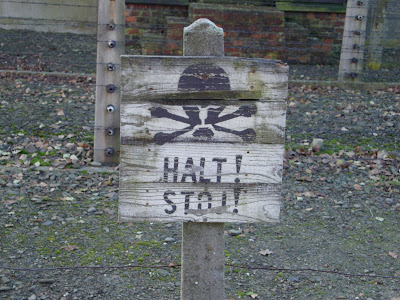
I think the meaning of this is pretty clear, even without the words. Basically, if you stepped beyond this sign you could expect a bullet in your brain (to some prisoners though, this was preferable to other horrors of the camp).


Electric perimeter fence - some inmates threw themselves on it, clearly deciding death by electrocution was better than death by a dozen worse methods (like starvation, for instance).


Perimeter fence and guard tower


The infamous 'Wall of Death' - a wall between two blocks where inmates were shot by firing squads.


This building doesn't look like much, but it's actually the gas chamber and crematorium which killed and cremated 60,000 people. The inside is an awful place - cold and oppressive, with a tangible presence in the air.

While Auschwitz 1 is a terrible place, Auschwitz 2 (Birkenau) is even worse - a very, very bleak place. Perhaps that's unsurprising since the camp hasn't changed much since over a million people died here. Birkenau was an extermination camp - Jews were transported here like cattle and lived in dreadful conditions, before being annihilated. An utterly sobering place.


The railway track that dissects the camp, with the main entrance in the background. To the left, watchtowers. To the right, blocks where inmates 'lived'.


Blocks and guard tower


More 'residence' blocks. This is what it is/was like - row upon row of nondescript blocks, some housing up to a thousand people in horrific conditions.


See what I mean? The interior of a block. Sometimes up to four people were crammed into a single bunk. There was no heating, no insulation. This is my own favourite from all the pictures I took of Auschwitz. And by favourite, I mean most affecting and harrowing. I think it sums up perfectly what those people went through.

The toilet block. Privacy - forget it. The Nazi mentality was that the Jews were worse than animals, so deserved to be treated as such. Ironically, this was the only place in the camp where the inmates found a bit of freedom, because the guards refused to enter. Subsequently, it had a secondary role as a black market, and place where news was exchanged. It had the added benefit of being the warmest place that the inmates had access to - figure out why for yourselves...

Amen to that. I just hope nothing like this ever happens ever again.

Friday, 20 November 2009

Crap fantasy book covers #19

I realised that it had been far too long since I've run a crap fantasy book cover feature - the last one was way back in April. So apologies to all you sadists out there that like nothing more than vomiting over horrendous covers - and I know there's a few of you! ;-)

So anyway, check out the Danish cover for Guy Gavriel Kay's second Fionavar novel.

Now, admittedly I've never read this book but I doubt it includes pink dinosaurs...does it? I also like the fact that you can't see the rider's saddle, so it looks like he's just randomly stuck on the dino's back. Plus the scale is all over the place - the figures in the background look to be too small. To round it off, either they're standing on a river of blood or the grass in Kay's world is red...

Utterly bizzarre.

Wednesday, 18 November 2009

Book review: Kell's Legend

Kell's Legend

By Andy Remic

(Angry Robot, 2009)

Those of you who have followed this blog for a while now probably know that I'm a huge fan of David Gemmell's novels. A hugely gifted storyteller, the great man's work was practically a sub-genre in its own right - no one could weave a tale about a flawed hero battling unspeakable odds (not to mention the darkness in their own soul) better than he could. Gemmell's death in 2006 left a huge vacuum in the British fantasy scene. Over the following years, I watched with interest to see whether a writer would come forward to pick up Gemmell's battleaxe and continue his fine tradition of thematic, emotionally-intensive heroic fantasy.

So when I read that Andy Remic, with his maiden fantasy novel Kell's Legend, was coming to "claim the post-Gemmell world" I sat up and took notice. The words were unmistakably bold and brazen, but the meaning was perfectly clear - someone had finally stepped forward to take up Gemmell's tradition and give it a new lease of life. A foolhardy task perhaps, but then Andy Remic clearly isn't a man to shirk such a challenge.

The classic Gemmell blueprint (which he used to great effect numerous times) was a simple plot, minimal world-building trimmings, and a huge focus on characterisation and development. Remic follows this practically to the letter.

The premise for Kell's Legend is uncomplicated: grizzled old axeman Kell is forced out of retirement when the city of Jalder is occupied by the Army of Iron, led by the merciless Vachine and relying largely on the magic of the terrifying Harvesters to defeat their enemies. Rescuing his granddaughter Nienna and her friend Kat from the invaders' clutches, they escape the city with the help of Saark, a perfumed dandy. Thus begins a desperate race to warn the King of Falanor about the invaders, with the hideous agents of the Vachine hot on their heels. Meanwhile, Anukis - a female Vachine, and an outcast among her kin - begins a painful journey of self-discovery...

Such a simple premise can be effective, but it relies almost entirely on the characters to drive the plot along- meaning that if Remic failed to nail the characterisation, the book would flounder. Fortunately, he delivers on this vital aspect. Some criticism has already been levelled at Kell and Saark, with some readers suggesting they are little more than a carbon-copy of Gemmell's  Druss the Legend and his sidekick, Sieben the Saga Master. Admittedly, the similarities are clear to see, and are not helped by the fact that the pair use some of the same words and phrases - Kell calling Saark laddie, Saark calling Kell old horse (though this is clearly a deliberate nod to Gemmell fans, and I quite liked it because of that). For the first quarter of the book I remained unconvinced, I felt the two characters were struggling to develop their own unique personalities and that perhaps Remic was wearing his Gemmell influences a little too obviously.

I was glad to see, therefore, that as the story progressed, Kell and Saark became their own men. Yes, Kell is clearly cut from the same cloth as Druss, but he's a darker version filled with self-loathing. The same is true of Saark - like Sieben he's a dandy and a womaniser, but he's a man at odds with himself, a man who possesses a self-destructive streak that pleasingly surfaces now and again. While the comparisons and similarities with Gemmell's famous pair will probably always persist, Kell and Saark are distinct enough to stand on their own feet, and Remic handles their relationship and interplay very well.

The rest of the cast are not just there to make up the numbers - Anukis makes for a decent female protagonist, her own story providing an interesting counterpoint to the main narrative drive forged by Kell and Saark. Graal is an intriguing villain, while Vashell is curiously unpredictable - one of those characters you think you're meant to hate, but just enough hints are dropped to make you think that perhaps you're wrong... Nienna and Kat are serviceable characters, but lack the depth of Kell and Saark  (there's no doubt Remic is more at home writing about ass-kicking axemen than teenage girls!).

While Remic does a decent job with the characterisation, he really delivers when it comes to pace and action. Kell's Legend is a blistering read; the pace is frenetic and the action scenes come thick and fast. Most chapters end on a cliffhanger - often in the middle of a combat scene - and this is a device Remic uses to very good effect. He's clearly honed his craft of creating pulsating action scenes during the writing of his military SF novels, for the fight sequences are often electrifying.

Don't make the mistake that this novel is just a big, dumb load of carnage - Remic throws some surprisingly fresh ideas into the mix. The Vachine are a great creation, being a technologically advanced race whose members are half flesh, half clockwork, while the cankers - the result of failed clockwork experiments - are another excellent touch. The whole clockwork element is not just there for show - it provides the motivation for the Vachine's invasion, and is also behind one the best (and most disturbing) scenes in the book. The Vachine society aside, the land of Falanor is fairly standard. That said, it's a pleasingly grim place of dark forests, bleak moors and decrepit cities, with place names that have a pleasing Gemmellian ring about them.

There are flaws of course, but they are relatively minor. Remic's prose is mostly sharp and solid but occasionally a sentence will run away with itself and ruins the writing's flow. The female characters lack the depth of their male counterparts. Some events seemed a little contrived, and/or unlikely. Most glaringly of all, a major event late on in the book takes place almost entirely off-screen, which makes it seem cheap and makes you wonder whether this was because Remic couldn't think of a way to portray it to the reader without it seeming rather ridiculous.

Verdict: Andy Remic may have seemed like an unlikely writer to snatch up Gemmell's battleaxe and continue to carve the fine tradition that the great man started, but he does a surprisingly good job of it. Kell's Legend is a rip-roaring beast of a novel, a whirlwind of frantic battles and fraught relationships against a bleak background of invasion and enslavement. In other words, it takes all the vital ingredients for a good heroic fantasy novel and turns out something very pleasing indeed. Remic is clearly a big Gemmell fan, and this really shines through. Kell's Legend won't be to everyone's tastes, and some may take exception to the similarities with Gemmell's work, but if you can keep an open mind then you may get a real kick out of one of the most surprising novels of the year.

Monday, 16 November 2009

Cover art for MMPB version of Nights of Villjamur

Very different from the hardback version:


The inclusion of a figure is almost inevitable; it's pretty much a prerequisite for a paperback cover (the sole intention of which is usually to shift as many copies of the book as possible, and screw anything else).

That said, I quite like this cover - it's certainly an improvement on the rough version I saw some time ago. I like the colours, and the fact that Randur is cast in shadow. I was initially a little concerned by the cityscape background, as on the rough version it was quite blocky, but it's been tidied up nicely here.

The representation of Randur doesn't match the picture I formed of him in my own mind (too much Aragorn and not enough dandy, for me) but of course this is personal preference. I'm not sure I'm a fan of the photo-realism gig that artists seem keen on these days, but this is a pretty decent example I guess.

Still, the hardback version is far superior in my own opinion.

Thoughts?

This paperback version will be released in June 2010, alongside the next book in the Legends of the Red Sun sequence, City of Ruin.

Update and linky links...

Just got back from a short break in Krakow, which is why there's been no blogging since last week (cool trip, hope to get some photos up soon). This coming week is going to be another busy one (I'm going to be putting in about 45 hours at work this week) so it's likely that there's going to be infrequent blogging for the next few days. However, from then onwards I hope my schedule is going to return to something representing normality and the blogging will pick back up again. 

Still, never fear - while you wait patiently for me to get my life back under control, there's been plenty of blogging from my fellow online scribes that's well worth checking out:

Aidan's been on a cover-art binge recently; he's posted the artwork for the upcoming Swords and Dark Magic anthology (which sadly is pretty dire - not at all worthy of the excellent line-up of contributing authors), and has also posted the American MMPB artwork for Joe Abercrombie's Best Served Cold (which is quite cool, certainly better than the dodgy hardback cover). Then we've got the cover for Brent Weeks' The Black Prism (which looks just like the covers for his debut trilogy, even though it's apparently completely unrelated - cynical marketing ploy 4tw!) and then finally we have the pretty awesome cover for the e-book of Robert Jordan's The Great Hunt. Aidan's also found the time to interview debut author Blake Charlton.

Graeme's reviewed The Cardinal's Blades by Pierre Pevel (I've got this one on my to-read pile, though it's some way down...) and has got a giveaway running for the same novel here. He's also reviewed Finch by Jeff Vandermeer. And of course, to satisfy his slightly alarming fixation with the living dead, Graeme's devoured (literally, I presume - while moaning braaaains) Essential Tales of the Zombie, Volume One. 

Wert has also reviewed The Cardinal's Blades and has written an excellent (as usual) new feature on a D&D world; this time around it's Dragonlance. He also attended the GRRM signing in Belfast, and has photos up of the event here along with a report in two parts, here and here.

Pat has reviewed The Dragon Keeper by Robin Hobb. 

Neth has reviewed the anthology Fast Ships, Black Sails and was not at all impressed. 

Pat Rothfuss had an entertaining rant about the writing life a while ago, which I didn't see anyone else comment on. It certainly makes for interesting reading. 

There's a number of excellent guest blogs over at Jeff Vandermeer's blog Ecstatic Days, particularly this one by Mark Charan Newton, who interviews Dan Abnett on the subject of media tie-in novels. 

Right, that's enough for now I think. 

In terms of content for Speculative Horizons, I hope to get a review of Terry Pratchett's Nation up in the next week or so, while I'm 3/4 of the way through Andy Remic's Kell's Legend, so hopefully a review of that will surface relatively soon too. As a stopgap in the meantime, I'll try and post up a few snaps of my sojourn to Krakow...including some pics of the nightmare that is/was Auschwitz. 

Have a good week! :)

Tuesday, 10 November 2009

Cover art and blurb for 'The Left Hand of God'

Yep, you guessed it - yet another 'hooded figure' cover. Although to be fair this one is pretty nice and superior to some of the awful ones out there.

The book itself sounds reasonably promising as well, certainly a bit different to some of the other 2010 debuts that mostly have failed to set my pulse racing. Here's the blurb:

The Sanctuary of the Redeemers is a vast and desolate place - a place without joy or hope. Most of its occupants were taken there as boys and for years have endured the brutal regime of the Lord Redeemers whose cruelty and violence have one singular purpose - to serve in the name of the One True Faith.

In one of the Sanctuary's vast and twisting maze of corridors stands a boy. He is perhaps fourteen or fifteen years old - he is not sure and neither is anyone else. He has long-forgotten his real name, but now they call him Thomas Cale. He is strange and secretive, witty and charming, violent and profoundly bloody-minded. He is so used to the cruelty that he seems immune, but soon he will open the wrong door at the wrong time and witness an act so terrible that he will have to leave this place, or die.

His only hope of survival is to escape across the arid Scablands to Memphis, a city the opposite of the Sanctuary in every way: breathtakingly beautiful, infinitely Godless, and deeply corrupt.

But the Redeemers want Cale back at any price… not because of the secret he now knows but because of a much more terrifying secret he does not.

One to keep an eye on, I think. The Left Hand of God is due for release in hardback on 7 January 2010.

Monday, 9 November 2009

Cover art and blurb for 'Thirteen Years Later'

Firstly, most of you have probably noticed that new posts here have been few and far between recently. No sinister reasons as to why - I've just been extremely busy both at work and at home, with various things demanding my attention. Unfortunately the blogging has had to take a back seat, though I hope that in the reasonably near future normal service will be resumed.

Anyway, for the time being check out the extremely cool artwork for Jasper Kent's Thirteen Years Later:


And here's the blurb:

"In the summer of 1812, before the Oprichniki came to the help of Mother Russia in her fight against Napoleon, one of their number overheard a conversation between his master, Zmyeevich, and another. He learned of a feud, an unholy grievance between Zmyeevich and the rulers of Russia, the Romanovs, that began a century earlier at the time of Peter the Great. Indeed, while the Oprichniki's primary reason for journeying to Russia is to stop the French, one of them takes a different path. For he has a different agenda, he is to be the nightmare instrument of revenge on the Romanovs. But thanks to the valiant efforts of Captain Aleksei Ivanovich Danilov, this maverick monster would not be able to begin to complete his task until thirteen years later. Now that time has come: it is 1825 and Russia once more stands on the brink of anarchy, and this time the threat comes from within..."

Twelve remains one of my favourite books of the year, and I'm highly anticipating this sequel. As for the cover art, I think it's great - a good example of how do a 'figure' cover properly.

Wednesday, 4 November 2009

Cover art and blurb for 'The King of the Crags'

Really like this cover for Stephen Deas's upcoming sequel to The Adamantine Palace, due for release in April 2010 from Gollancz.

Here's the blurb:

"Prince Jehal has murdered, poisoned and betrayed his way to the top. There is a new speaker for the realms, his opposition has been crushed, now he just has to enjoy the fruits of power. And yet . . .

He feels more for the wife he married for power than perhaps he should and his lover knows it. And out in the realms those loyal to the old regime are still plotting. and there are rumours that the Red Riders, heralds of revolution and doom are on the ride. And still no-one has found the famous white dragon. The dragon that, if it lived, will have long since recovered from the effects of the alchemical liquid fed to the dragons of the realms to keep them docile, to block their memories of a time when they ruled and the world burned . . ."

Sounds very promising. Really need to get around to reading The Adamantine Palace so I'm ready for when The King of the Crags lands...

Friday, 30 October 2009

US deal for Jasper Kent

Twelve by Jasper Kent remains one of my favourite reads of the year - a historical fantasy involving vampires that would eat their fluffy namesakes in Twilight for breakfast. The book has been a real success in the UK - according to agent John Jarrold it's the "second-highest-selling trade paperback debut novel right across UK publishing in 2009."

It's now been announced that Kent has signed a two-book deal with Pyr in the US, for the release of Twelve and its sequel Thirteen Years Later.

From John Jarrold's blog:

‘I'm thrilled to be welcoming Jasper Kent into the Pyr fold,’ says editorial director Lou Anders. ‘TWELVE is a magnificent blend of a historical novel and a dark fantasy novel, that could appeal equally to readers both in and out of genre. Jasper is a skilled storyteller, whose compelling prose had me hooked from his opening chapter. The book is "un-put-downable," and I love that he has brought back a real sense of threat and danger to the classic monsters, something that has been lacking with too many vampires lately. I cannot wait to spring this on US readers.’‘

Jasper and I are delighted with this deal, and looking forward to working with Lou and his colleagues,’ said John Jarrold. ‘Pyr is a terrific company, who publish many of my favourite authors, and Lou’s enthusiasm has to be seen to be believed!’

Congratulations to Jasper - I'll be interested to see if the success the book has enjoyed in the UK will be replicated across the Atlantic.

Wednesday, 28 October 2009

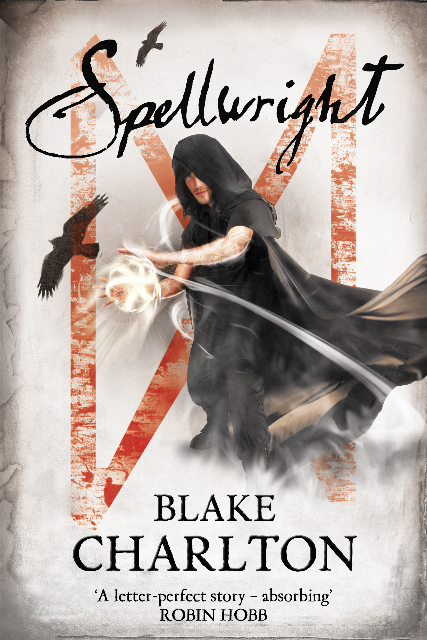
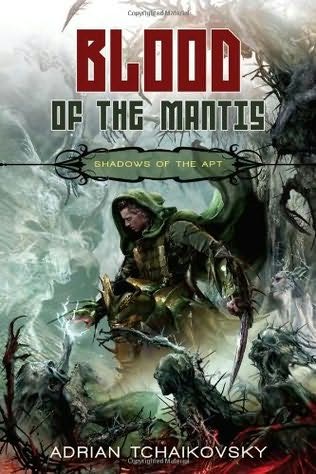
Enough with the hooded figures...

Another day, another 'hooded figure' fantasy book cover...


Is anyone else getting thoroughly sick of these sort of covers? I understand why they're used (for some reason, these covers sell books) but come on, if you have to put some sort of figure on the front of the book, then at least make the cover look decent.

The above cover represents everything that's wrong with this particular trend - it's unoriginal, bland, and poorly executed. It looks for all the world like someone pulled it out of their arse during lunchbreak. As I've said many times before, it's no wonder people think the genre is a load of crap when we have terrible covers like this on the covers of our books.

Thanks to Aidan for the heads-up on this one.

Tuesday, 27 October 2009

Book review: Triumff - Her Majesty's Hero

Triumff - Her Majesty's Hero

By Dan Abnett

(Angry Robot, 1 October 2009)

Dan Abnett is a name that is perhaps not familiar to many genre fans, so it may come as a surprise to hear that his Black Library novels set in Games Workshop's Warhmmer 40k universe have sold millions of copies. Media tie-in novels often receive a bad press, but this is often unjust - by all accounts, Abnett's 40k books are some of the best military SF out there. I've been meaning to check his work out for a while, and Triumff conveniently gave me the perfect opportunity - a brand new novel set in an original setting. 

"Sir Rupert Triumff. Adventurer. Fighter. Drinker. Saviour? Pratchett goes swashbuckling in the hotly anticipated original fiction debut of the multi-million selling Warhammer star. Triumff is a ribald historical fantasy set in a warped clockwork-powered version of our present day! A new Elizabethan age, not of Elizabeth II but in the style of the original Virgin Queen. Throughout its rollicking pages, Sir Rupert Triumff drinks, dines and duels his way into a new Brass Age of Exploration and Adventure."

It did occur to me that perhaps Triumff wouldn't be the best place to begin my Dan Abnett experience, since the book represents something of a stylistic and creative departure for the author. However my fears were swiftly dispelled - despite spending much of his time writing about a grim, war-torn future, Abnett makes an effortless and laudable transition to spinning a ripping yarn about a future England where the Elizabethan age never ended, and magic sits uncomfortably alongside technology. Abnett deserves credit for this; if I didn't know better, I would have thought he'd been writing this sort of material for his whole career - it's that convincing. 

The prose is arguably the novel's strongest point: fluid and atmospheric, and underpinned by a classic, dry British humour that really makes the novel. There are some truly excellent puns, which I won't repeat here. That said, I must admit I didn't find the novel as funny as I hoped - much of the humour brought a smile to my face, but mostly didn't make me laugh (the bath-house scene was a notable exception - if only there were more scenes that made use of that style of humour). At times it did feel like the humour was a little excessive - less is often more. 

I did particularly like the nods to contemporary Elizabethan formatting and styles, with the amusing footnotes and chapters with titles such as The Twenty-Fourth Chapter: Never mind the bal-rogs. The way that the story's narrator, one William Beaver Esquire, occasionally tries to ingratiate himself into the novel's important events also provides some entertaining moments. 

For a reasonably short novel (331 pages) Abnett manages to throw a surprising number of characters into the mix, the most prominent of course being the gentleman of the title - Sir Rupert Triumff, who comes across as something of a cross between Edmund Blackadder and Errol Flynn (although about 20% in favour of the former, and 80% of the latter). I did find myself wishing that Triumff possessed a sharper, wittier personality. This perceived deficiency unfortunately inflicted the supporting cast as well. Disappointingly, I didn't find any of the characters to be particularly memorable or entertaining, and I did struggle to really care about any of them. While Triumff is of course intended as a tongue-in-cheek humorous romp, this doesn't mean characterisation is any less important - and for me it wasn't quite there. One or two characters - Lord Salisbury, for example - came across as pale reflections of what they could have been. 

The plot is surprisingly expansive for a book of both this type and length, and for the most part is constructed well. However, Triumff now and again disappears into the background and becomes something of a spectator in his own story, which is a little odd. The pacing is generally good, although at times is hindered as Abnett goes off in search of another pun that takes too long to materialise. This is a minor complaint though, and it must be said the story builds to a satisfying climax, with a nice twist thrown in for good measure. 

Verdict: Something of a mixed bag, in truth - arguably the execution doesn't quite match the vision. The alternative England that Abnett has created is wonderfully drawn and the atmosphere created by the style of the prose is excellent, with some very amusing puns and scenes thrown into the mix. The characterisation though - while serviceable - didn't quite hit the spot for me, the plotting could be construed as a little uneven at times, and the humour (or the attempt at it) sometimes overpowered the narrative. Still, despite its flaws, Triumff is an entertaining read and a solid demonstration of Abnett's talent for diversification and style.

Monday, 26 October 2009

Blurb for Miéville's new novel 'Kraken'

Fans of China Miéville have been wondering for some time when the author would return to his fascinating world of Bas-Lag - the last novel set in that world was 2004's Iron Council (which seems to be generally regarded as something of a disappointment). Miéville then decided to move away from the setting, citing in an interview that he didn't want to become 'the guy that wrote Bas-Lag novels.'

Nothing wrong with wanting to try something a little different, but it was a rather curious move to risk potentially alienating some of the fans he'd gained through the Bas-Lag books. The move arguably caused a degree of pressure, since his two subsequent novels - Un Lun Dun and The City and the City - received mixed reviews.

However, it finally looks like us Miéville fan-boys are getting what we want - a return to the world of Bas-Lag with his new novel Kraken. While it's not yet definitely been confirmed as a Bas-Lag novel, the blurb - to me - seems reminiscent of Bas-Lag:

"The Natural History Museum's prize exhibit - a giant squid - suddenly disappears. This audacious theft leads Clem, the research scientist who has recently finished preserving the exhibit, into a dark urban underworld of warring cults and surreal magic. It seems that for some, the squid represents a god and should be worshiped as such. Clem gradually comes to realise that someone may be attempting to use the squid to trigger an apocalypse. And so it is now up to him and a renegade squid-worshiper named Dean to find a way of stopping the destruction of the world as they know it whilst themselves surviving the all out-gang warfare that they have unwittingly been drawn into..."

Three words - bring it on. This blurb has got me rather excited; it's vintage Miéville. No cover art yet, but no doubt it'll materialise soon. Release date has been slated as 7 May 2010. Can't wait for this one, The Scar is one of the best fantasy novels I've ever read, so my expectations are pretty high (especially since I was rather disappointed by The City and the City).

Must try and read Perdido Street Station and Iron Council before Kraken is released...

Edit: I've emailed Pan Mac for confirmation on whether Kraken is a Bas-Lag novel, will let you know if I find out anything...

Interviewed...again!

Harry over at Temple Library Reviews runs an excellent feature called 'Reviewer Time' in which he aims to get to know the bloggers behind the various genre blogs a little better. I've been a regular reader of this series of interviews, except this time around I found myself on the receiving end of Harry's questions!

In the Q&A I talk about my blogging experiences and the genre scene in general. I also explain why I cannot touch spirits without dire consequences (I mean with regards to drinks, not actual spirits!).

Anyway, it was a lot of fun and I'd like to thank Harry for letting me be a part of his excellent feature! Do check out the earlier interviews with my fellow bloggers too, there's some really enjoyable material there!

Thursday, 22 October 2009

Guy Gavriel Kay slaps down anti-SF Booker judge

Interesting article by Canadian fantasy author Guy Gavriel Kay over at The Globe and Mail, in which he comments on some of the recent squabbles about genre books not been recognised for prestigious literary awards, and so forth.

Pleasingly, he picks up on Kim Stanley Robinson's rant about the Booker prize, ridiculing John Mullan in the process (remember -the clown that said SF was "bought by a special kind of person who has special weird things they go to and meet each other.")

Mullan's response to Robinson's criticisms is, according to Kay, "Hall of Fame-quality idiocy." He goes on to say, "I do admit to wondering what size shoe Professor Mullan wears, and how it fits between his teeth, and whether he teaches grammar."

Kay is surprisingly optimistic when it comes to contemplating the future of the genre with regards to prestigious literary awards:

"I'm optimistic. I've had, for some time, a sense that demographics will (as so often) have their way with us, this time leading in a good direction. Speculative fiction (SF and fantasy) is simply embedded in the culture and world view of too many younger writers (from Pulitzer Prize winner Michael Chabon to Pulitzer Prize winner Junot Diaz). I have an sense that this is already eroding many of the barriers thrown up by prejudice and assumptions in the literary world.

We'll find ourselves working away from category and genre debates and toward the question worth asking about any novel: Is it any good?

Here's a prediction: One day soon enough, someone may wear double-pleat pants and a bow tie to accept the Man Booker Prize for a science fiction or a fantasy novel. It will start an uproar – among the fashionistas."

I'll be among the first to raise a toast to such an uproar, if it ever happens. Interestingly, Kay remarks on the same point that Mark Charan Newton made a while back - that the genre really needs to move away from debates and bitchfights about categories and the attitude of the mainstream, and focus more on the important questions - like whether a book is actually any good or not.

Anyway, pat on the back for Kay as I think he's spot on. Must check out some of his books soon...

Wednesday, 21 October 2009

Book review: The Island

The Island

By Tim Lebbon

(Allison and Busby, 2009)

"Kel Boon thinks he has managed to escape his past as an agent in the secret organization the Core, protecting the blissfully unaware Noreelans from the threat of the lizard-like Strangers - creatures from beyond the known world capable of untold destruction. In the sleepy fishing village of Pavmouth Breaks, Kel has become the woodcarver, leaving fighting behind and forming a tentative relationship with trainee witch Namior. But a storm is brewing and at its center the witches sense something dark, and deadly. What follows in the wake of the storm threatens the Noreelans' very way of life, forcing them to face the fact that life exists beyond the shores of Noreela, and not all of it is friendly. With the people and land he loves in terrible danger, Kel quickly realizes that he cannot escape his past, or his destiny."

With The Island, Tim Lebbon has established himself in my mind as a good writer that isn't afraid to try something a little different. His previous effort, Fallen, was an enjoyable adventure romp with some excellent characterisation and a healthy dose of mystery. More than that, it was a good example of how Lebbon approaches familiar storylines from different angles, and conjures up something a little bit different. Fortunately the same is true of The Island - a very different book to Fallen, yet imbued with the same solid characterisation, flowing prose and general freshness.

Kel Boon and Namior Feeron are well-developed protagonists; Lebbon flits with ease from one perspective to the other, building a believable relationship dynamic between the two. Kel's background is skilfully revealed through a series of flashbacks that never halt the momentum of the story, and his character arc peaks nicely as he struggles between his dual loyalties. Namior at first seems little more than an emotional foil for Kel, yet she turns out to have a few secrets of her own. Lebbon works these revelations into the story very well, without them seeming contrived or unrealistic.

Despite the limited geographic scope of the novel (90% of the story takes place in the fishing village of Pavmouth Breaks and its immediate environs) Lebbon manages to make the setting both intriguing and dynamic enough for the story's requirements. Noreela is proving to be an interesting place, and as in Fallen Lebbon reveals little touches here and there that make the world all the more detailed (my favourite was the fish that can be played like a pipe!).

The only real criticism I would level at The Island is that I feel - like Fallen - the ending is a little underwhelming; there's an aspect to the resolution of the plot that just felt a little cheap to me (not to mention rather unlikely). But this flaw aside, Lebbon deserves credit for constructing a well-constructed plot that unfolds at an even pace, with a really fresh feel to it (I personally can't recall reading anything particularly similar) that mixes suspense with emotional gravitas and some good old-fashioned brawling. It's always nice to read a novel where I don't have the faintest idea how it's all going to end.

Lebbon's prose is another strong point - perhaps not as lyrical here as it was at times in Fallen, but as always it's crisp and fluid, striking a perfect balance between exposition, description and action.

Verdict: An enjoyable addition to the 'Noreela' series, featuring a world that becomes more intriguing with each novel. The Island is a fast, entertaining read that makes a good argument for why you should be reading Tim Lebbon's work.

George R. R. Martin confirms London appearance

George R. R. Martin has confirmed that in addition to his Belfast book-signing dates, he will also be appearing at London's Forbidden Planet store on 11 November 2009, at 5.30 pm.

Meeting GRRM is a must for any fan of his work, but I definitely recommend any genre fan to go along regardless of whether they are familiar with his books, since it's not often you get to meet such a legend of the genre.